Last updated November 17, 2026
Free written scope consultation - allowances, timeline, and change-order rules on paper before a single trade is scheduled
The Complete Driveway & Pavers Guide for Garden Grove Homeowners
Garden Grove sits on expansive clay soils that can exert upward pressure measured in the thousands of pounds per square foot, a fact most paver quotes never mention and most base calculations never account for. That single geological detail explains why a driveway that looks flawless in April can show spider cracks and settled edges by the following summer. In this guide, we’ll walk through the base depth Garden Grove driveways actually need, how concrete, brick, and porcelain pavers hold up against 90°F surface temperatures, what the City of Garden Grove reviews before a driveway replacement is approved, and how to read an installation quote line by line so you can spot a thin base before it fails.
Quick Answer
A driveway in Garden Grove needs a compacted Class II aggregate base of 6 to 8 inches, not the 4 inches common in drier inland specs, because the clay-heavy soil here expands and contracts with seasonal moisture. Material choice matters too: brick and porcelain pavers on that base outlast poured concrete in this climate, and most full driveway replacements of roughly 500 square feet land between about $9,000 and $18,000 installed depending on material and site conditions. Get the base spec in writing before anyone breaks ground.
Styles & brands we work with
- Kitchen remodeling
- Bathroom remodeling
- Home additions & ADU
- Roofing
- Windows & doors
- Driveway & pavers
- Fence
Table of Contents
- Why Garden Grove Soil Changes Everything
- How Deep Should the Base Be?
- Concrete vs. Brick vs. Porcelain Pavers
- Material Brands and Price Per Square Foot
- Permits and Drainage Review in Garden Grove
- How to Read a Paver Quote Line by Line
- The Installation Process, Step by Step
- Maintenance for Southern California Driveways
Why Garden Grove Soil Changes Everything
Garden Grove’s clay-heavy substrate is the quiet cause of most driveway failures in the city. Clay expands when it absorbs water and shrinks when it dries, and in a Southern California climate that swaps wet winters for dry summers, that cycle repeats every year. Expansive clay can generate upward pressure in the thousands of pounds per square foot range, and a driveway base that isn’t engineered for it will telegraph that movement straight up through the surface.
We see the pattern most in neighborhoods built out during the postwar boom, where original concrete driveways are now 50 to 70 years old and the soil beneath them has been moving the whole time. In areas like the West Garden Grove tract homes and along the older streets near the historic downtown core, we regularly find slabs that cracked not from traffic but from seasonal heave. Compaction done once under a dry summer sun doesn’t hold when the winter water table rises, which is why base prep here can’t be copied from a quote written for Riverside or Bakersfield.
The practical takeaway: the soil report, not the paver catalog, is the foundation of the project. Ask what base spec your contractor is using and why it fits Garden Grove’s ground.
How Deep Should the Base Be?
For most Garden Grove driveways, plan on 6 to 8 inches of compacted Class II aggregate base under pavers. That’s the material spec that gives you a stable, drainable layer between moving clay and the pavers above. The 4-inch base common in drier inland markets is too thin for soil that moves this much.
Here’s how the layers stack up in a properly built Garden Grove driveway:
- Subgrade preparation: Strip the old surface, then proof-roll and compact the exposed clay. Any soft spots get excavated and replaced, not paved over.
- Geotextile separation fabric (where specified): A woven fabric between clay and base stops fine soil particles from pumping up into the aggregate and weakening it.
- Class II aggregate base: 6 to 8 inches, placed in lifts of roughly 4 inches and compacted each lift to a high relative density. Thick lifts compact poorly.
- Bedding sand: A thin, screeded layer of concrete sand to set pavers on.
- Pavers and edge restraint: Set to the manufacturer’s pattern, then locked with edge restraints and joint sand.
We check base compaction with the same discipline we apply across trades under Clause 1 of the Haven Standard, where the written scope states the base depth and the number doesn’t change after the digging starts.
Concrete vs. Brick vs. Porcelain Pavers
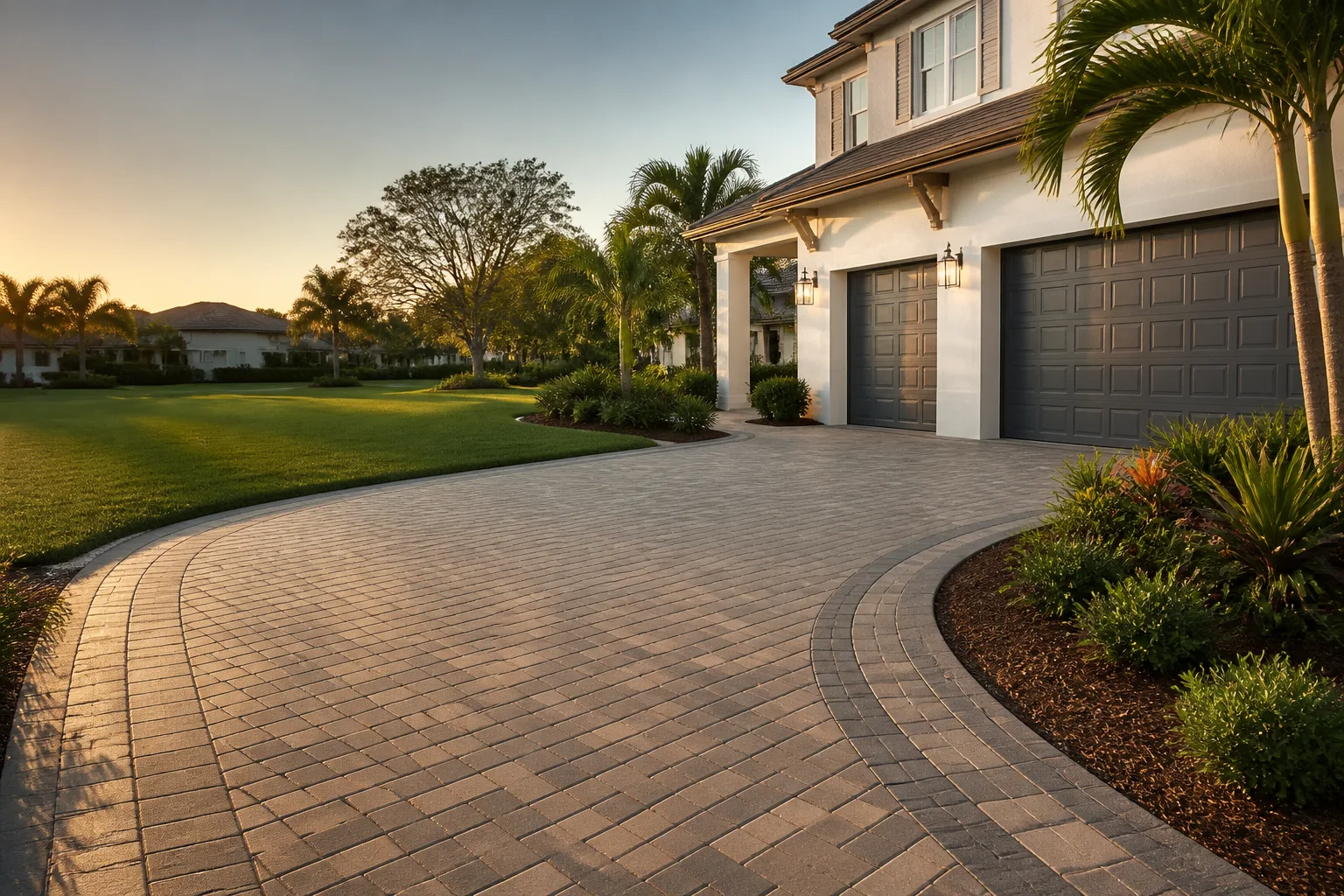
Poured concrete, brick pavers, and porcelain pavers fail in different ways in Garden Grove, and the comparison isn’t only about looks. Concrete resists compressive force well but has almost no tolerance for the flex that clay movement creates, so it cracks. Pavers flex at the joints instead, which is why they hold up better here.
| Surface | Typical Strength | Behavior in Garden Grove |
|---|---|---|
| Poured concrete | ~3,000-4,000 PSI compressive | Hard surface, minimal flexibility; cracks when clay heaves. Repairs are visible. |
| Clay brick pavers | ~8,000+ PSI compressive | Flexes at joints, absorbs movement, repairable one unit at a time. |
| Porcelain pavers | High compressive strength, low water absorption | Stain and heat resistant; higher material cost and a more exacting install. |
Thermal expansion matters on 90°F-plus summer afternoons. Concrete moves as one continuous slab and needs control joints to manage it; individual pavers with open joints take that same thermal load more gracefully. In Garden Grove, material PSI ratings, water absorption, and thermal movement properties should appear on a quote before price is discussed.
Material Brands and Price Per Square Foot
Brand choice drives both cost and lead time. Here’s how the commonly specified pavers compare by installed price per square foot in the Garden Grove market, along with typical lead times from Orange County distributors.
- Belgard: Broad concrete paver line with strong color consistency. Roughly $12 to $20 per square foot installed; local distributor lead times usually run 1 to 3 weeks.
- Pavestone: Budget-friendly concrete pavers, widely stocked locally. Roughly $10 to $15 per square foot installed; often available in 1 to 2 weeks.
- Techo-Bloc: Premium concrete and slab pavers with modern profiles. Roughly $15 to $25 per square foot installed; lead times of 2 to 4 weeks are common.
- Porcelain slab pavers: Premium price tier, roughly $18 to $35 per square foot installed, with longer lead times and a more specialized install.
Those numbers include base prep, sand, edge restraint, and joint sand. Some specialty and slab products share pallets with brands like Boral, PGT, and CGI that distributors stock alongside the core paver lines, so confirm what’s actually on the dock before you commit to a date. Our Driveway & Pavers in Garden Grove page lays out material options in more detail.
Permits and Drainage Review in Garden Grove
A driveway replacement in Garden Grove often triggers a city review you wouldn’t expect. A straight like-for-like paver swap on an existing footprint may need only a right-of-way encroachment permit if crews work near the sidewalk, but changing the driveway’s dimensions, grading, or how water drains off the property can bring in a grading and drainage review. That addendum matters here because clay soil plus hard surfaces equals runoff that has to be directed away from foundations and the public street.
What the City of Garden Grove typically looks at:
- Encroachment permits for any work in the parkway or crossing a sidewalk.
- Grading review when slope, elevation, or the drainage pattern changes.
- Whether water is directed toward or away from the street and neighboring properties.
- Setback and width limits along the property line.
Because requirements shift with the scope, the safe move is a written scope that states who pulls the permits and who covers inspection. Every Rowan project under the Haven Standard has that written before work begins. If grading forces a new fence or gate line, that conversation overlaps with our Fence Installation in Garden Grove work.
How to Read a Paver Quote Line by Line
A paver quote tells you almost everything in how it lists base prep. A legitimate quote breaks the job into visible line items; a thin one bundles everything into a single number and hides the base. Reading it carefully is the single best way to avoid a driveway that fails in year three.
- Demolition and haul-away: Should be listed separately with a disposal line, not folded in.
- Excavation depth: The number that matches your base depth. If base is 6 inches, excavation should account for base, bedding, and paver thickness.
- Base material and compaction: A quality quote names Class II aggregate, the depth, and the compaction spec.
- Geotextile or separation fabric: An optional but honest line for clay soil. If it’s absent, ask why.
- Pavers, pattern, and waste factor: Should state the manufacturer, product name, and a realistic overage for cuts.
- Edge restraint and joint sand: Never bundled into “miscellaneous.”
- Drainage and permits: Broken out, with who handles each.
If a quote shows one number with no base line, request the breakdown before you sign. If you already have a competitor’s estimate in hand, we’ll review it line by line at no charge as a second opinion.
The Installation Process, Step by Step
Here’s what a careful Garden Grove driveway installation looks like from the homeowner’s vantage point.
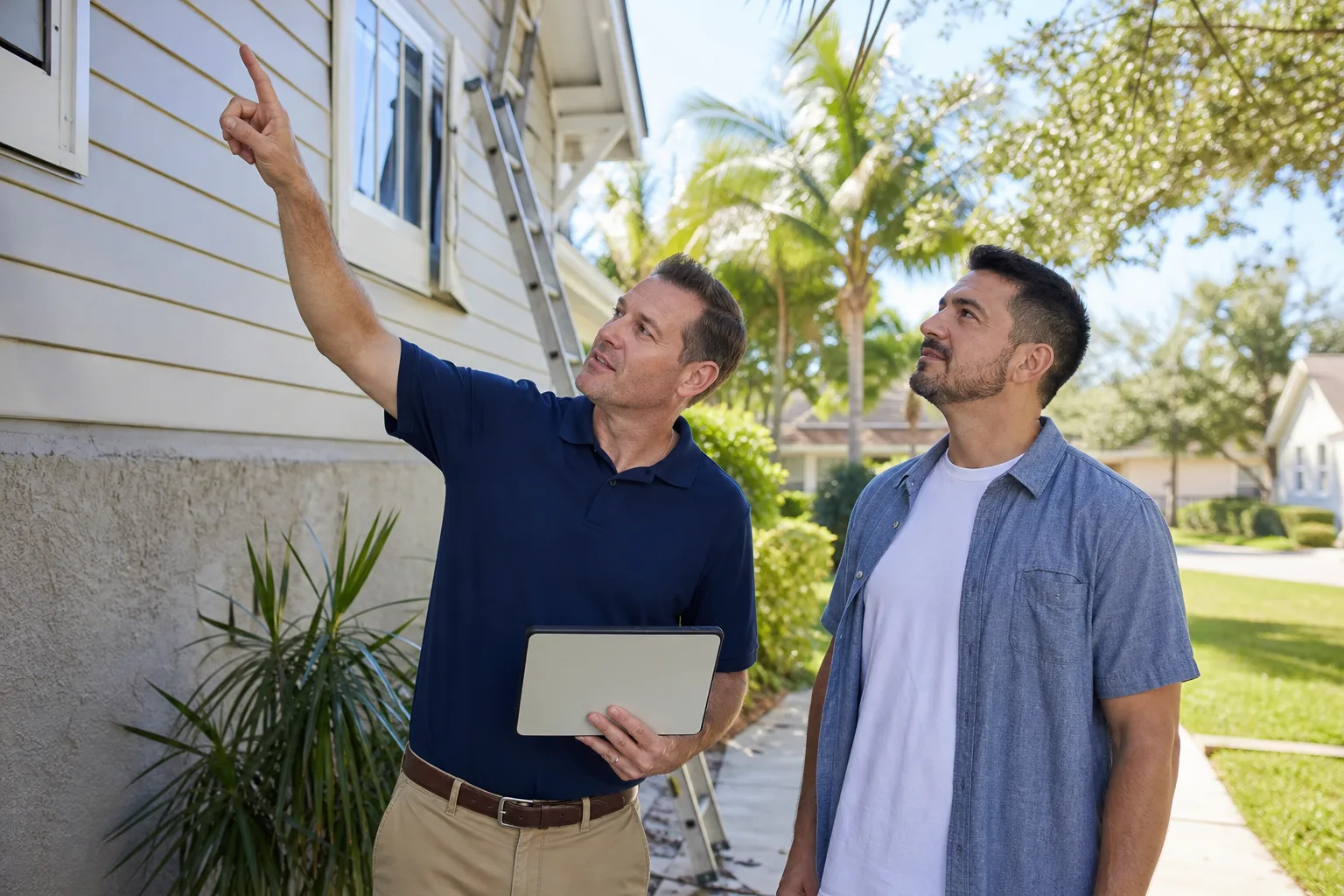
- Walkthrough and written scope, including base depth and material spec.
- Photo documentation of the existing slab and soil conditions before demolition.
- Demolition, haul-away, and subgrade inspection.
- Base placement in lifts, compaction, and proof checks.
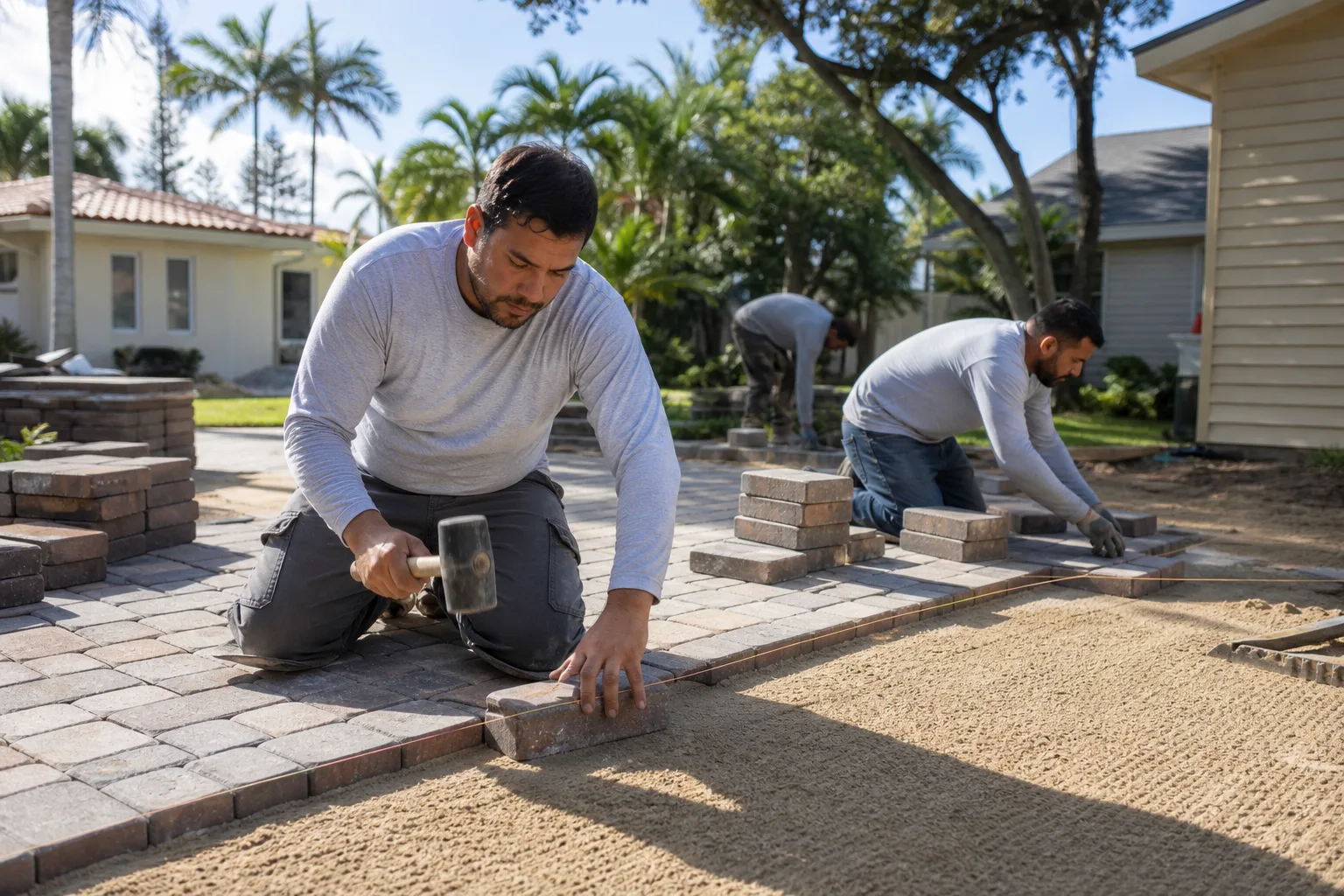
- Setting the pavers to the agreed pattern, then edge restraint and joint sand.
- Final walkthrough with the photo record and a written warranty in hand.
If a driveway upgrade sits inside a larger plan, like a garage conversion or a new entry approach, it connects to our Home Additions & ADU in Garden Grove work, where site access and grading have to be planned together.
Maintenance for Southern California Driveways
Pavers don’t need sealing every year, but Garden Grove’s dry summers make joint sand the thing to watch. Joint sand locks the pavers against movement; when it washes out over a few seasons, individual units start to shift at the edges. Top up the joint sand once a season and treat heavy stains by pulling and resetting a single paver rather than re-surfacing the whole drive.
After winter rains, take five minutes to check where water goes. If it pools against the garage or the house foundation, the drainage plan needs a second look, not another layer of pavers.
Common Mistakes to Avoid
- Copying an inland base spec. A 4-inch base works in dry desert markets but not on Garden Grove’s moving clay. Insist on the soil-appropriate depth.
- Skipping compaction in lifts. Piling 8 inches of aggregate and compacting once leaves a soft core that settles.
- Bundling the whole job into one number. A quote that hides base prep is a quote you can’t compare. Demand the line items.
- Ignoring drainage. Clay soil plus a hard surface sends water somewhere. If the plan doesn’t say where, ask before signing.
- Choosing material by price alone. Cheap pavers on a poor base still fail. The base is the value.
- Overlooking the permit question. A width or grade change can require a city review that a straight swap doesn’t.
- Skipping the photo record. Without before-and-after documentation, you can’t see what was dug or how it was built.
See the difference
 Before
 After
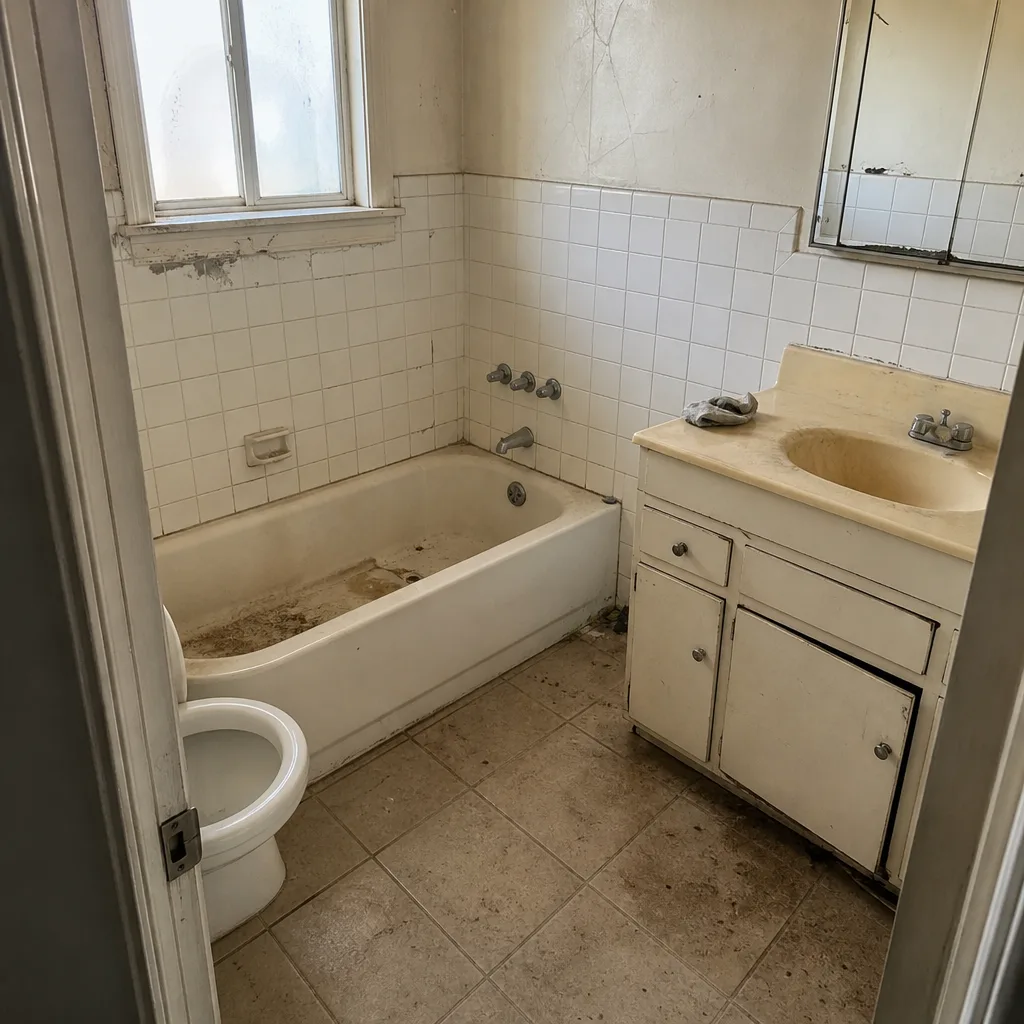
 Before
 After
 Before
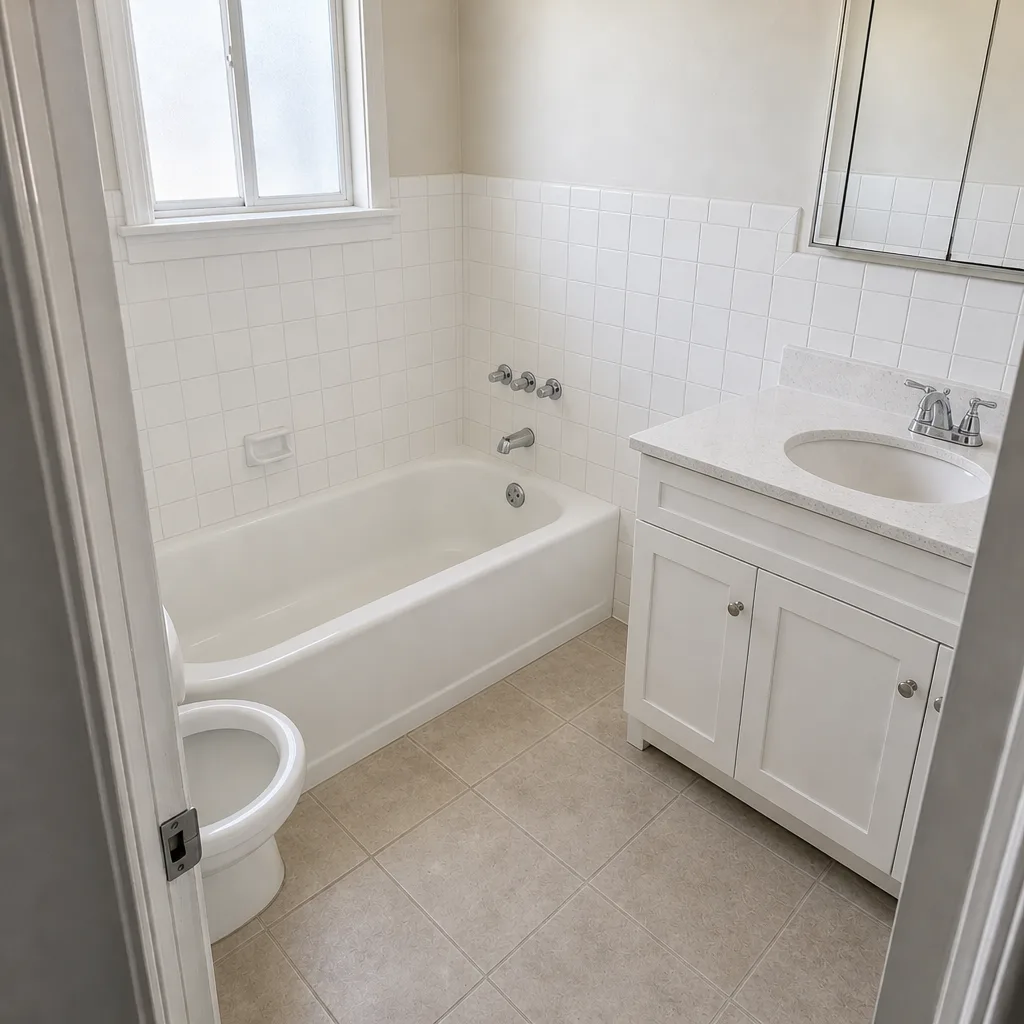 After
When to Call a Professional
Call a licensed contractor when you’re looking at a full driveway replacement, a change to grading or drainage, or a foundation-adjacent surface that’s showing settlement. Heavy pavers, a properly compacted base, and permit review are not tasks for a weekend. If your current driveway is heaving at the garage apron, if water pools against the house after storms, or if a prior install is failing within a few years, a professional assessment will tell you whether you’re facing a repair or a rebuild. Rowan Construction Group Garden Grove offers free estimates in Garden Grove. Call (888) 303-8980.
Frequently Asked Questions
Most full paver driveways in Garden Grove run about $10 to $25 per square foot installed, depending on material brand and site conditions, so a 500-square-foot driveway lands roughly between $9,000 and $18,000. Base depth and drainage needs are the biggest variables. Call (888) 303-8980 for an exact quote, and estimates are free.
On a Rowan project, no work proceeds on a change until a change order is signed, so the price you agreed to stays the price unless you and we agree in writing to something new. That discipline is what has kept our projects within a few percent of the agreed cost.
It depends on the scope. A like-for-like swap may only need an encroachment permit if crews work near the sidewalk, while a width or grade change can trigger a grading and drainage review. Your written scope should state who pulls the permits and handles inspections.
Most residential paver driveways take about three to five working days on site, plus lead time for the material from your Orange County distributor. Weather and permit timing can stretch that window. Call (888) 303-8980 to schedule a free estimate and get a realistic timeline for your address.
For expansive clay soil, pavers usually hold up better because they flex at the joints instead of cracking through a continuous slab, and a single damaged unit can be pulled and reset. Concrete stays a viable budget option when the base is built to spec. The right answer depends on your property and budget.
Yes. Every project gets a flat written price and written scope before any work begins, backed by the 365-Day Done Right Promise. We also offer a free second-opinion review of any competitor estimate, line by line.
The Bottom Line
A Garden Grove driveway is only as good as the ground under it. Build on 6 to 8 inches of properly compacted Class II base, choose a pavers material rated for hot Southern California summers, get the permit and drainage questions answered in writing, and read your quote line by line so you can see the base prep on the page. Do those four things and the surface on top becomes simple. Skip them and no paver, at any price, will save the job. When you’re ready to see the numbers in writing, we’re ready to show them.
Start with a free estimate and a walk-through of Rowan Construction Group’s Garden Grove home page so you can compare your project against the full range of what we build. When you’ve got a written estimate, call (888) 303-8980 to schedule your free estimate and put the base spec and the price on paper before anyone picks up a tool.
Written by the team at Rowan Construction Group Garden Grove.