Last updated November 17, 2026





Free written scope consultation - allowances, timeline, and change-order rules on paper before a single trade is scheduled
Bathroom Remodeling Maintenance Schedule: What to Do and When
The average bathroom remodel in Southern California costs $12,000 – $28,000. Most of that money is reclaimed by water damage within a decade, and not because the original work was bad. It happens because no one handed the homeowner a calendar on day one. Grout starts failing at year three to five. Caulk seals give out at year one to two. Exhaust fans clog at year seven to ten. Miss those intervals in a Garden Grove bathroom and a $12,000 remodel quietly becomes a $20,000 one. This guide gives you the task-by-task schedule, the products that hold, and the dollar thresholds for when a DIY fix stops being enough.
Quick Answer
A bathroom needs four recurring tasks: inspect caulk joints every 12 months and re-caulk when you find gaps, seal grout every 2 – 3 years depending on porosity, clean the exhaust fan every 6 months, and check for moisture damage at every transition point once a year. Everything else is annual inspection or as-needed repair. The full calendar below runs monthly through every ten years.
Styles & brands we work with
- Kitchen remodeling
- Bathroom remodeling
- Home additions & ADU
- Roofing
- Windows & doors
- Driveway & pavers
- Fence
Table of Contents
- The Full Maintenance Calendar: Month by Month and Year by Year
- Caulk: The First Line of Defense (and the First Thing to Fail)
- Grout Sealing: Intervals by Material
- The Exhaust Fan: Your Cheapest Insurance
- Cosmetic Wear vs. Structural Moisture: How to Tell the Difference
- Dollar Thresholds: When DIY Stops Being Enough
- Garden Grove-Specific Factors: Water, Sun, and Coatings
- The Printable Annual Checklist
The Full Maintenance Calendar: Month by Month and Year by Year
Treat the bathroom the way you treat the HVAC filter: fixed intervals, not “when I notice something.” Here’s the schedule we hand to every bathroom remodeling client in Garden Grove.
Monthly (5 minutes):
- Wipe down the shower surround and squeegee glass after use; this alone extends caulk life by a year or more.
- Check under the sink for slow drips or dark spots on the cabinet floor.
- Run the exhaust fan during and 20 minutes after every shower. If it’s not clearing the mirror within five minutes, the fan is underperforming.
Every 6 months:
- Remove the exhaust fan grille, vacuum the blades, and wipe the housing.
- Test the toilet supply line and shutoff valve for corrosion or a stiff turn.
- Look at the silicone bead around the tub and shower pan. Run a fingernail along the edge; if it lifts, it’s failing.
Every 12 months:
- Full caulk inspection at every wet joint (tub rim, shower pan, backsplash, sink edge).
- Check window seals in bathrooms with natural light (a Garden Grove concern, covered below).
- Re-seal stone countertops if the surface darkens when water sits on it.
- Flush the water heater and check the anode rod if the bathroom shares a tank with the rest of the house.
Every 2 – 3 years: Grout sealing, interval depending on material (see the grout section below).
Every 5 – 7 years: Replace the toilet flapper and fill valve. Inspect the shower valve cartridge for mineral buildup.
Every 7 – 10 years: Plan for exhaust fan replacement. Motors lose capacity long before they fail outright.
This is the same rhythm our technicians use when they walk a Rowan Construction Group Garden Grove home for a post-remodel check, and every visit comes with a documented photo record so you know exactly what was found and what was done.
Caulk: The First Line of Defense (and the First Thing to Fail)
Caulk is the cheapest part of a bathroom and the most important. It’s also the first thing to fail. In a shower that gets used daily, a standard latex caulk bead can lose adhesion within 12 – 18 months. When it does, water gets behind the tile and into the substrate, and that’s where the real money starts going.
Not all caulk is created equal. Three formulas worth knowing:
- GE Silicone II (100% silicone): The gold standard for wet areas. Rated service life of 10 years in a static joint under normal conditions. Downsides: it doesn’t accept paint, and it can’t be applied over old silicone. Surfaces must be bone dry and clean.
- DAP 3.0 Kitchen & Bath: A siliconized acrylic that bonds to wet surfaces and is paintable. Rated life of roughly 5 years in wet areas. Easier to work with, but it will not last as long as 100% silicone in a shower pan.
- Polyurethane (e.g., Sika or Loctite PL): Overkill for interior joints but useful around exterior window frames in bathrooms with natural light. Rated life 15+ years.
For a shower pan to wall transition, use 100% silicone and nothing else. For the backsplash to countertop transition (dry area), DAP 3.0 is fine and easier to redo.
Application matters as much as product. The single biggest reason caulk fails prematurely is applying it over a wet or dirty joint. Surfaces must be clean, dry, and free of old silicone (silicone remover or a plastic scraper, then isopropyl alcohol). The bead should be pushed, not smeared, and tooled with a silicone shaping tool rather than a finger.
Grout Sealing: Intervals by Material
Grout is porous. Even sealed grout is porous eventually. How often you re-seal depends entirely on what type is on the floor and walls.
- Cementitious (traditional) grout, sanded: Re-seal every 2 years in shower areas, every 3 years elsewhere. Test by dropping a few beads of water on the joint; if they soak in within a minute, it’s due.
- Cementitious grout, unsanded: Same intervals, but more prone to cracking at narrow joints. Inspect annually for hairline cracks.
- Epoxy grout: Effectively non-porous. Doesn’t need sealing. Rated life of 20+ years with proper cleaning. If you have this, you’re already ahead; skip the sealing step and inspect annually for physical damage instead.
- Urethane grout: Sealer is built in. Re-seal only if you see absorption, which is rare before year 8.
The tester is a water bottle. Fill a spray bottle, mist a grout joint, and watch. If water beads, the sealer is holding. If it darkens the grout, it’s time to re-seal.
Sealer choice matters here too. For showers, a penetrating solvent-based sealer (e.g., Miracle Sealants 511 Impregnator) is the standard. For floors, an enhancing sealer will darken the grout slightly but gives 3 – 5 years of protection between applications. Skip topical sealers on shower floors; they trap moisture and peel.
The Exhaust Fan: Your Cheapest Insurance
A bathroom exhaust fan does more work in a single morning shower than most people assume. It pulls 50 – 110 cubic feet per minute (CFM) of humid air out of the room, which is the difference between caulk drying in place and caulk staying wet 24 hours a day. When the fan clogs or weakens, humidity climbs, and everything downstream in the bathroom ages faster.
Fans fail on the quiet side. Blades clog with lint and dust, motors lose torque, and by year 7 – 10 the fan is moving half the air it did new. Nobody notices until the mirror fogs and doesn’t clear.
The maintenance is short:
- Every 6 months, cut power at the breaker and remove the fan grille (usually a friction-fit or two screws).
- Vacuum the blades and the inner housing with a brush attachment. A shop vac works best. Wipe with a damp cloth.
- Check the backdraft damper (the little flap behind the fan) to confirm it moves freely and closes. A stuck damper lets humid air and cold air back in.
- Reinstall the grille, restore power, and test by holding a square of toilet paper up to the grille. If it falls, the fan isn’t pulling enough (roughly under 40 CFM). Replacement is usually the correct fix.
A replacement Panasonic WhisperCeiling fan (the standard 110 CFM model) runs about $130 – $220 for parts, plus $150 – $300 for installation if a new circuit or duct route is required. That’s the cheapest moisture control you can buy in a Garden Grove bathroom.
Cosmetic Wear vs. Structural Moisture: How to Tell the Difference
Not every crack or stain is a problem. But some are. The distinction matters because one is a $30 tube of silicone, and the other is a $1,200 subfloor repair.
Cosmetic (address eventually):
- Hairline craze patterns in glaze or grout surface, with no depth
- Fading or darkening on the floor finish in high-traffic areas
- Slight mildew on caulk surface that cleans with bleach solution and leaves no gap
Structural moisture (address immediately):
- Tile lippage: One tile edge sits above its neighbor. On its own, lippage is cosmetic. Combined with dark grout, moisture is likely getting behind and swelling the substrate below.
- Efflorescence: A white, chalky powder on grout or tile that reappears after cleaning. That’s mineral salt drawn out by moisture moving through the assembly. The moisture has to be found and stopped.
- Hollow spots when tapped: Tap the tile with the handle of a screwdriver. A sharp “clack” tells you the tile has separated from the thinset. A hollow tile with a dark grout joint is almost always a moisture issue.
- Grout that crumbles when you poke it with a fingernail: The grout has lost adhesion to the tile edge. Water is already behind it.
- Soft spots at the toilet flange or shower curb: Press with a screwdriver handle. Any give at all means rot.
If you find any of the “structural moisture” signs, stop re-sealing and get the moisture source found. Sealing over a wet assembly traps water and accelerates the damage.
Dollar Thresholds: When DIY Stops Being Enough
Knowing when to stop DIY-ing is the difference between a maintenance budget and a remodel. Here’s where the line sits, in actual dollars:
- Re-caulking a shower surround: $30 in materials (GE Silicone II, caulk gun, tooling), 2 – 3 hours DIY, or $150 – $400 from a professional if you’re not comfortable on a ladder or working with silicone.
- Re-sealing grout in a standard 5×8 bathroom: $80 – $150 in materials DIY, or $250 – $500 professionally with a penetrating sealer.
- Exhaust fan cleaning: $0. This is vacuuming, not repair.
- Exhaust fan replacement: $130 – $220 parts, $150 – $300 install if a new circuit or vent route is needed.
- Re-grouting a shower floor (full removal and re-grout): $400 – $900 professional. DIY is possible but the failure rate is high.
- Subfloor replacement (the cost of 18 months of unaddressed caulk failure): $1,200 – $3,500 depending on how far the rot spread.
- Full shower pan replacement (the cost of 3 – 5 years of unaddressed grout failure): $3,500 – $8,000.
- Full bathroom remodel triggered by deferred maintenance: $8,000 – $15,000 beyond what a maintenance budget would have cost.
The pattern is simple: the earlier task is 1/10 the cost of the later task. That’s the entire argument for a maintenance schedule. If you’re sizing up that full remodel number and reconsidering the scope, our Home Additions & ADU in Garden Grove team also handles bathroom renovations from the framing up, and every project starts with a written price before anyone picks up a tool.
Garden Grove-Specific Factors: Water, Sun, and Coatings
A maintenance schedule written for a Portland bathroom won’t hold in Garden Grove. Two local variables change the intervals: the water and the sun.
Hard municipal water. Garden Grove draws from a blend of imported Colorado River water and local groundwater, which means moderate-to-high mineral content at the tap. That mineral load has two effects:
- Fixture wear: Aerators, showerheads, and toilet fill valves accumulate scale faster than in soft-water cities. Descale showerheads quarterly, not yearly. Replace toilet fill valves at 5 years, not 7.
- Soap scum adhesion: Soap scum bonds to the grout and tile matrix more aggressively with hard water, which means the monthly squeegee habit pays bigger dividends here. Skipping it is what ages a Garden Grove shower surround twice as fast.
High UV exposure. Bathrooms with natural light through south- and west-facing windows get more UV than most homeowners expect. The visible damage shows up at the window seal (silicone or glazing compound chalks and cracks at year 3 – 5 in direct sun, versus 7 – 10 in a shaded room), and at the edge of any wood vanity where sunlight and humidity together push and pull the finish. Re-caulk exterior-facing window frames every 3 years, not every 5, if the bathroom gets morning or afternoon sun.
Coatings that hold up here. For exterior-adjacent fencing around bathroom window wells and side yards, we see Jerith aluminum and Bufftech vinyl hold color and dimensional stability better than wood through Garden Grove’s UV cycles; when we spec a fence alongside a bathroom addition, those are the brands we lean toward. Details on those choices live on our Fence Installation in Garden Grove page.
One more local variable: with the number of 1950s – 1970s ranch homes in Garden Grove, bathroom remodels frequently get done over original framing and galvanized plumbing. If a maintenance inspection turns up recurring moisture at a wall, it’s often the original plumbing behind the tile, not the tile itself. Our Driveway & Pavers in Garden Grove crews see the same aging drainage issues on the exterior; the moisture usually starts outside the house.
The Printable Annual Checklist
Print this. Put it inside the vanity cabinet door. Check off each line and date it.
Monthly
- [ ] Wipe down shower surround after each use (squeegee)
- [ ] Under-sink moisture check
- [ ] Confirm exhaust fan clears mirror within 5 minutes of shower
- [ ] Descale showerhead (quarterly minimum in Garden Grove)
Every 6 months
- [ ] Vacuum exhaust fan grille and blades (breaker off first)
- [ ] Check backdraft damper movement
- [ ] Inspect toilet supply line and shutoff valve
- [ ] Fingernail test at caulk joints (tub rim, shower pan, backsplash)
Every 12 months
- [ ] Full caulk inspection and re-caulk failed joints
- [ ] Window seal inspection (every 3 years if bathroom gets direct sun)
- [ ] Tap-test tiles for hollow spots
- [ ] Re-seal stone countertops if water darkens the surface
- [ ] Inspect for efflorescence (white chalky powder) on grout
Every 2 – 3 years
- [ ] Grout re-seal (every 2 years for cementitious in shower, every 3 for floors)
- [ ] Water-bead test on grout to confirm sealer performance
Every 5 – 7 years
- [ ] Replace toilet flapper and fill valve
- [ ] Inspect shower valve cartridge for mineral buildup
Every 7 – 10 years
- [ ] Plan exhaust fan replacement (motor capacity test)
- [ ] Full tile and waterproofing inspection by a professional
Common Mistakes to Avoid
- Sealing over a wet assembly. If moisture is already behind the tile, sealer traps it in. Find the source before you seal the surface.
- Using paintable latex caulk in a shower pan. It’s rated for 2 years in a wet joint, not 10. Shower pans get 100% silicone, always. The $25 you save on product costs $1,200 in subfloor work.
- Applying new caulk over old silicone. Nothing sticks to silicone. It must be fully removed first, not layered.
- Ignoring a foggy mirror. In Garden Grove, a slow-clearing mirror almost always means the exhaust fan needs cleaning or replacement, and the fan is doing half its job for years before anyone notices. That humidity ages everything downstream.
- Treating grout darkening as “patina.” Dark grout that won’t clean up with a soft brush and baking soda is a moisture signal, not a color.
- Skipping the annual window seal check. In a Garden Grove bathroom with high UV exposure, the window seal can fail in 3 years where a shaded room would last 10. Catching it early is a $30 fix; catching it late is sill and casing replacement.
- Assuming maintenance is unnecessary because it was a “new remodel.” Every bathroom, no matter how well-built, needs caulk inspection at year 1. That’s not a defect; it’s physics.
See the difference
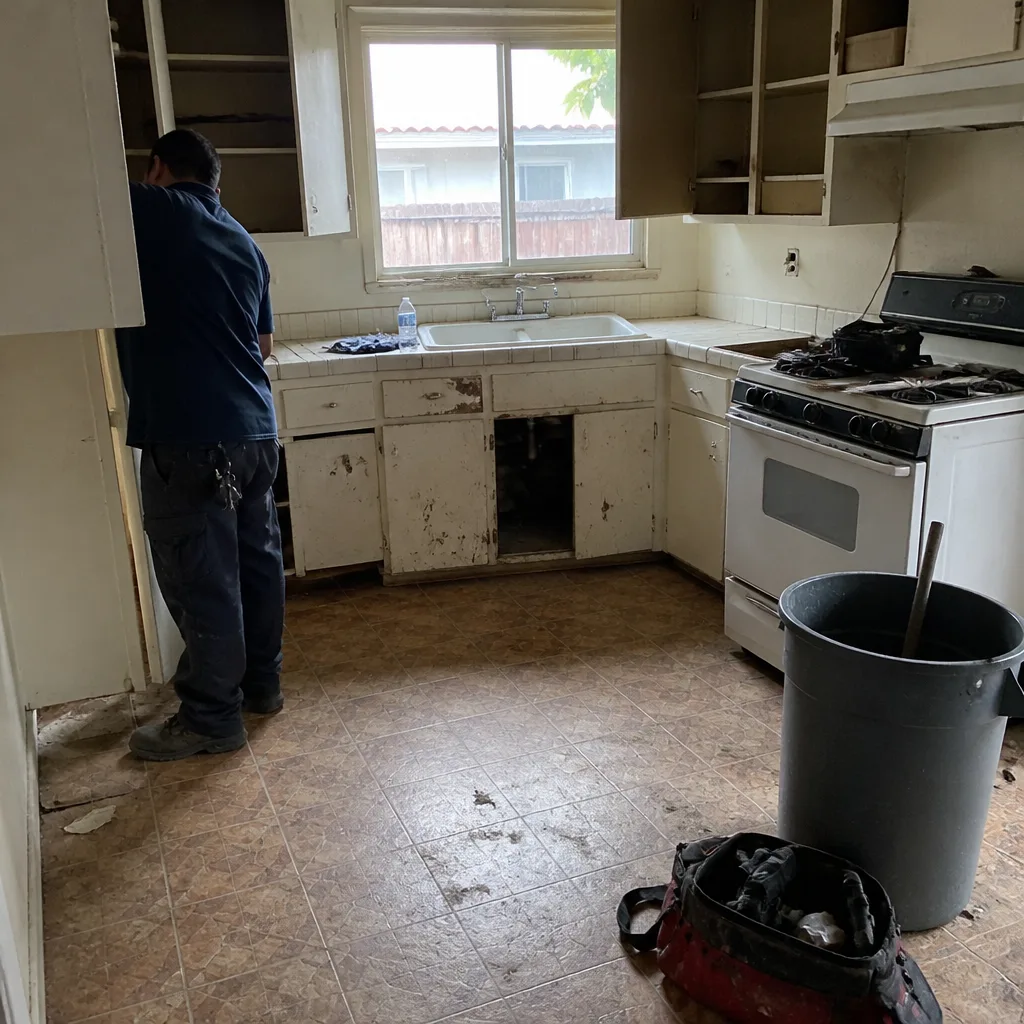 Before
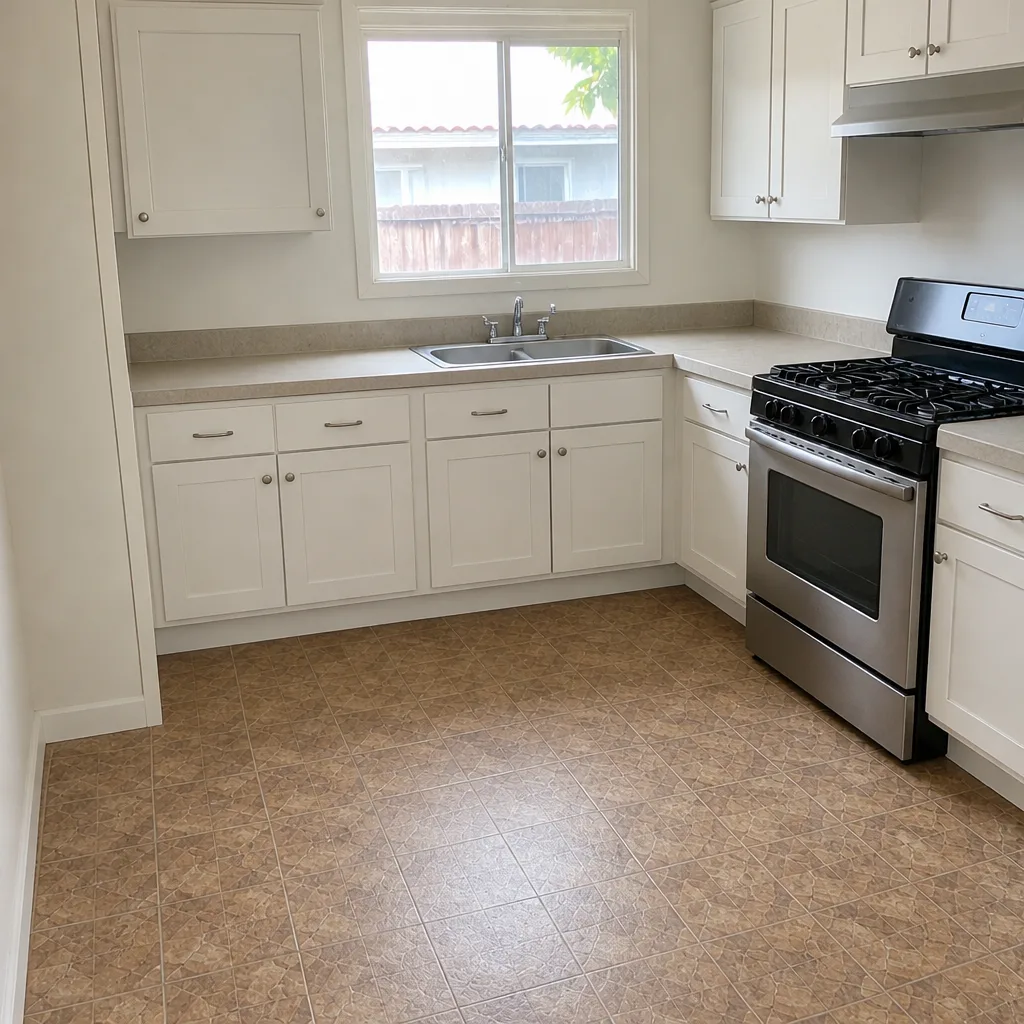 After
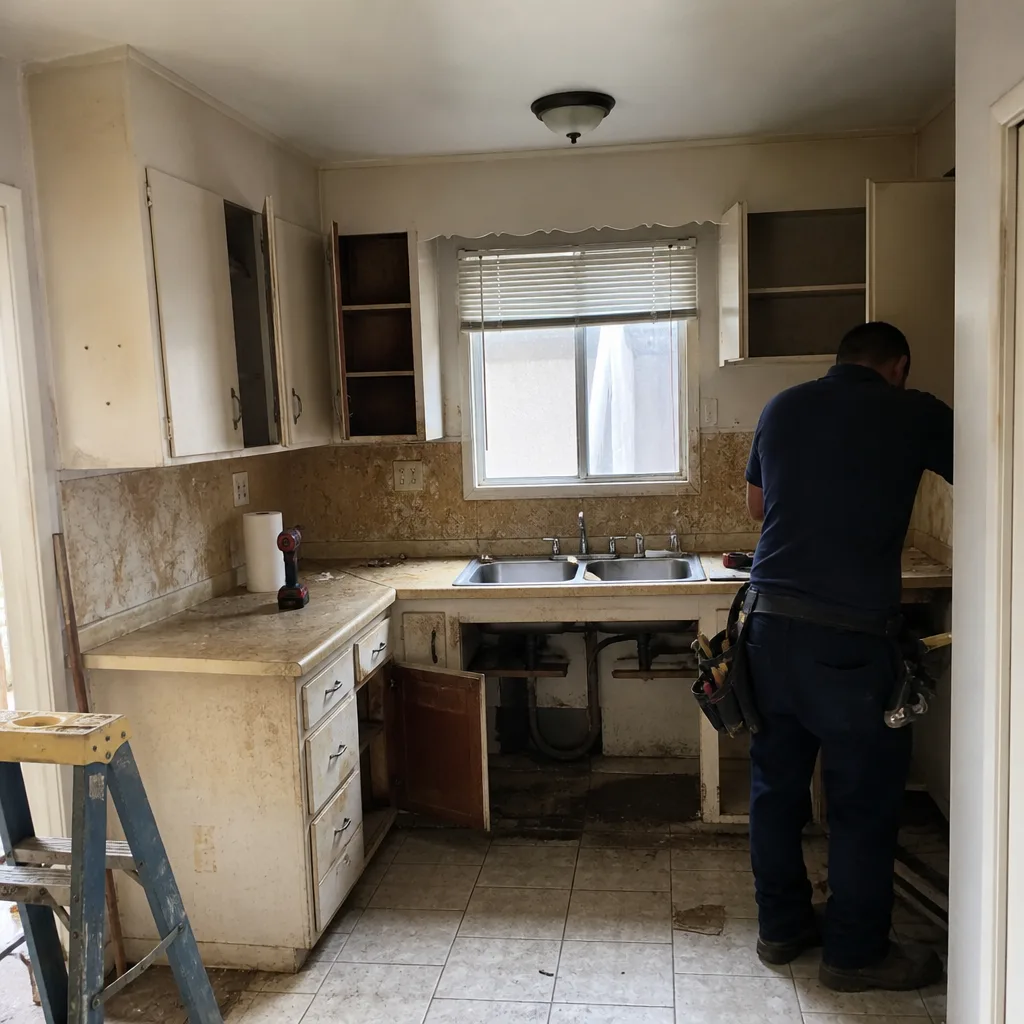 Before
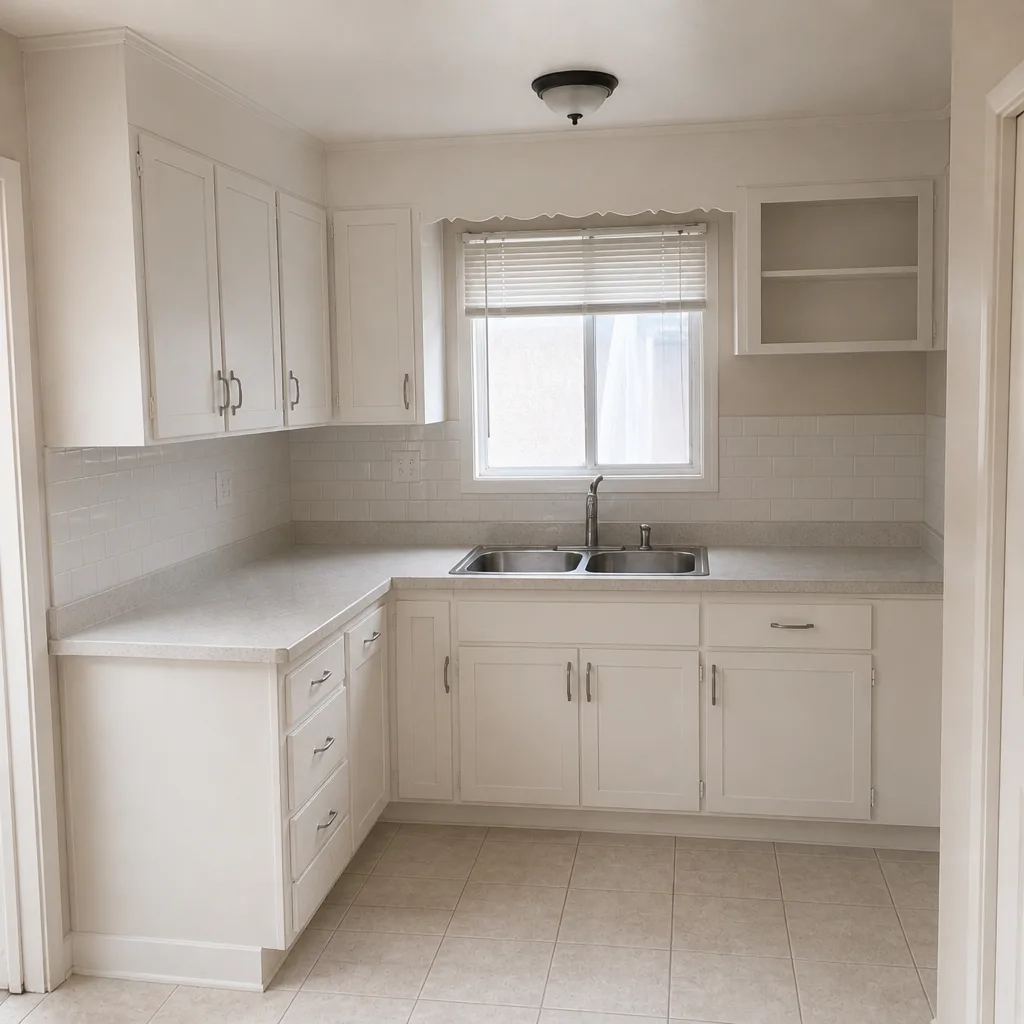 After
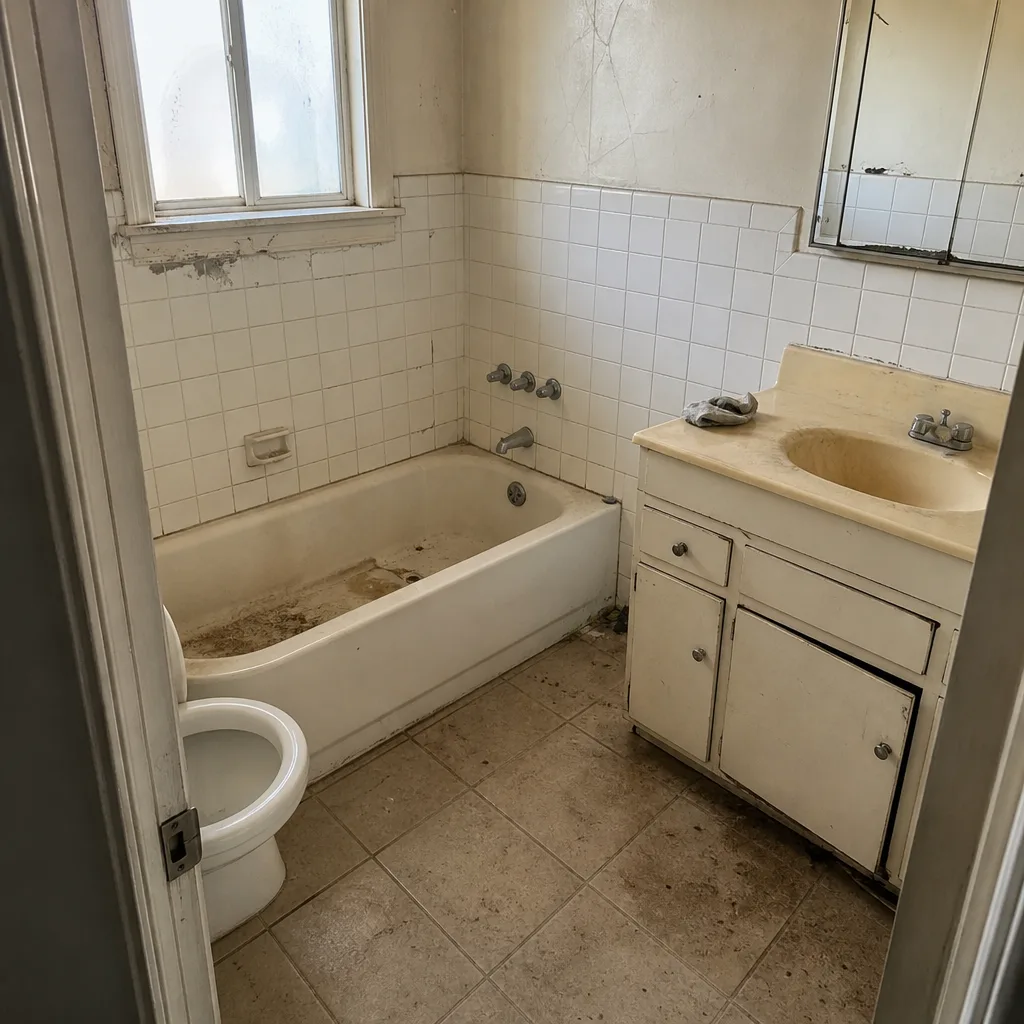 Before
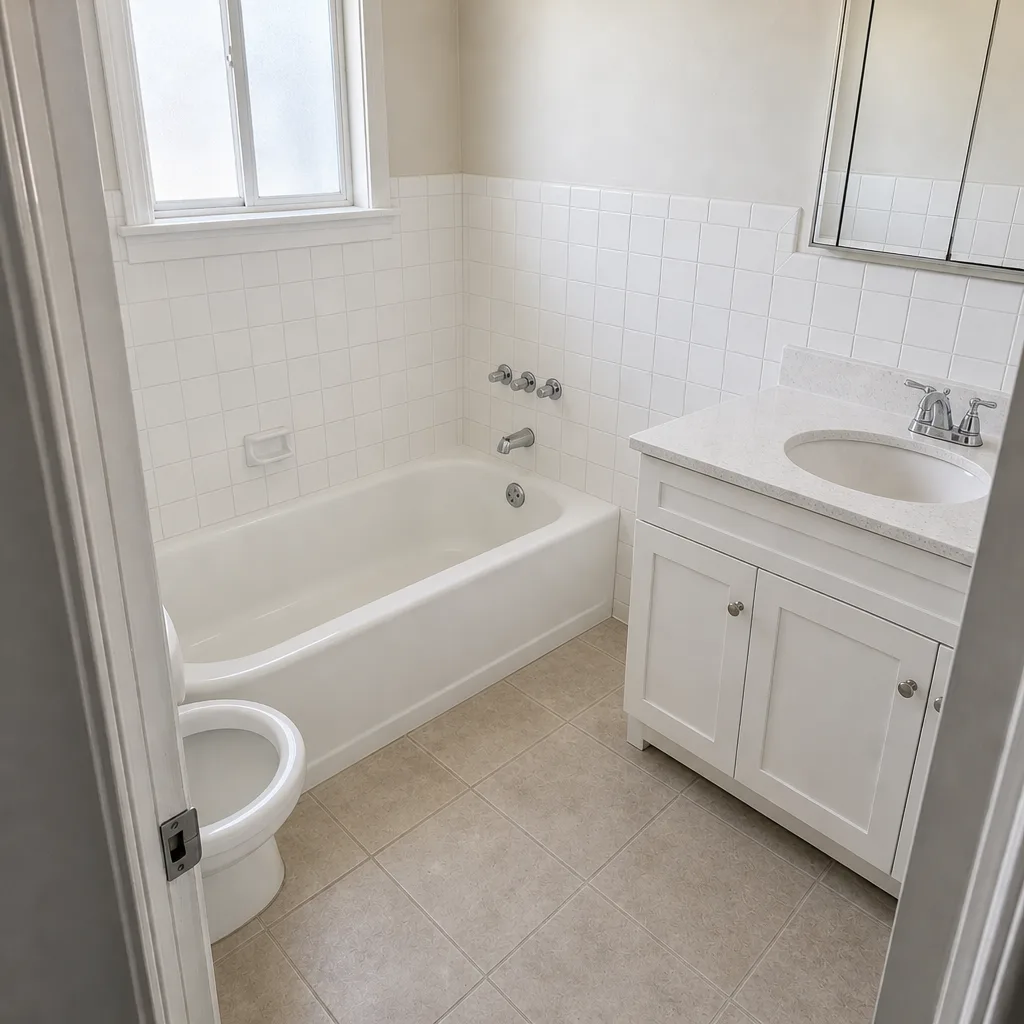 After
When to Call a Professional
Some maintenance is a Saturday morning project. Some of it is a work order. Call a professional when you find hollow tile with dark grout joints, efflorescence that reappears after cleaning, soft spots at the shower curb or toilet flange, any tile lippage combined with grout failure, or exhaust fan replacement that requires a new vent route or electrical circuit. Also call when you’re past three years without a caulk inspection and the shower gets daily use. Re-caulking a shower pan is a $150 – $400 job; repairing a rotted subfloor is $1,200 – $3,500. The threshold between the two is essentially the point where you stop feeling confident probing the joint. Rowan Construction Group Garden Grove offers free estimates in Garden Grove, with a written price and written scope before any work starts, and a Free Second Opinion on any competitor’s written estimate, line by line, at no charge. Call (888) 303-8980.
Frequently Asked Questions
Re-caulk the shower and tub surround every 12 – 18 months if the bathroom is in daily use, and inspect every joint annually regardless. In Garden Grove’s hard water and moderate humidity, silicone joints in a daily-use shower last about 12 – 24 months before they need redoing. Use 100% silicone (GE Silicone II or equivalent) in wet joints and re-caulk the moment a fingernail can lift the edge. Call (888) 303-8980 for a free estimate if you’d rather we handle the re-caulk and document the joints with photos on our way out.
Yes, and sooner than most people think. New cementitious grout should be sealed 72 hours after installation (once fully cured) and re-sealed every 2 years in the shower, every 3 years elsewhere. Epoxy and urethane grouts are effectively self-sealing and don’t require scheduled re-application. If a contractor installs cementitious grout and doesn’t hand you a sealer schedule, that’s the first maintenance task to add to your calendar. Call (888) 303-8980 for an estimate on re-grouting or re-sealing.
Four signs point to a leak behind the tile: white chalky powder (efflorescence) that reappears after cleaning, hollow-sounding tiles when tapped, grout that crumbles under a fingernail, and tile lippage combined with dark grout joints. Any one of these warrants a professional moisture inspection, since the cost of catching it early ($200 – $500 for a finding-and-repair) is a fraction of the subfloor cost if it’s not caught ($1,200 – $3,500). Call (888) 303-8980 to schedule an inspection.
A typical Garden Grove bathroom remodel runs $12,000 – $28,000 depending on scope, tile choice, and whether plumbing and framing are replaced. A cosmetic refresh (paint, fixtures, re-caulk, re-grout) lands at $3,500 – $8,000. The bigger swings come from what’s behind the wall; a 1950s ranch with original galvanized plumbing can add $2,000 – $4,000 in scope once the wall opens up. Rowan’s written price is a flat number, not a range, and it comes before work starts. Call (888) 303-8980 for a free written estimate.
Yes, if the bathroom sees daily shower use. The fan pulls lint and dust through the grille and onto the blades, and by month 6 it’s noticeably underperforming in most households. A dirty fan pulls roughly 60% of its rated CFM, which means humidity lingers, and humidity is what ages everything else in the bathroom. Cleaning is a 15-minute job with a vacuum and a damp cloth. Call (888) 303-8980 if the fan is 7+ years old and starting to struggle even when clean; replacement is usually the right answer.
Not in our work. Under Clause 1 of The Haven Standard, a written price and written scope are delivered before any work starts, and no change proceeds until a change order is signed. That’s the discipline that has kept our projects within a few percent of the agreed price across 4,000-plus jobs. If a repair turns up something the original scope didn’t cover, we document it with photos and you sign the change order before anyone picks up a tool. Call (888) 303-8980 for a free estimate.
The Bottom Line
A bathroom remodel is a capital investment that depreciates on a schedule. Caulk fails at year 1 – 2, grout sealers at year 2 – 3, exhaust fans at year 7 – 10. Catch each on its interval and the bathroom holds its value; miss them and the repair bill climbs by a full order of magnitude. Garden Grove’s hard water and high UV exposure shorten those intervals further, which is why the schedule above leans toward the conservative side. Every visit from our team includes a documented photo record, so you have evidence of what was found and what was fixed, not just a verbal report. The 365-Day Done Right Promise covers the work itself. The maintenance calendar is what keeps it good for the decade after.
Call Rowan Construction Group Garden Grove at (888) 303-8980 for a free estimate, a written price before any work starts, and a free second opinion on any written estimate you’re comparing. A live person answers calls 24/7, and every visit ends with photos in your inbox.
Written by the team at Rowan Construction Group Garden Grove.