Last updated November 17, 2026

Free written scope consultation - allowances, timeline, and change-order rules on paper before a single trade is scheduled
Driveway & Pavers Maintenance Checklist for Garden Grove Homeowners
The most common paver repair call we get in Orange County isn’t cracked stones. It’s a sunken section – a driveway that looks fine from standing height until you drive a tire over the wrong corner and feel the thud. Behind that thud is polymeric sand that washed out quietly over two rainy seasons while the surface still looked perfect. In Garden Grove, pavers fail in a predictable sequence: winter rains expand the clay-heavy soil under the base, summer UV bakes the joints, and the whole thing loosens from underneath. This guide gives you a date-stamped inspection protocol tied to Garden Grove’s actual weather calendar, so you catch the problem at the $80 fix stage instead of the $4,000 re-lay stage.
Quick Answer
Driveway pavers in Garden Grove need inspection twice a year – once in October before the rains and once in April after them – with joint sand top-offs every 18 to 24 months and a fresh UV-rated sealer application every 3 to 5 years. The single most important check is joint depth: if polymeric sand has dropped more than a quarter-inch below the paver surface, the base is already vulnerable to water infiltration and needs attention before the next rain.
Styles & brands we work with
- Kitchen remodeling
- Bathroom remodeling
- Home additions & ADU
- Roofing
- Windows & doors
- Driveway & pavers
- Fence
Table of Contents
- Why Garden Grove Pavers Fail in a Predictable Sequence
- Polymeric Sand Joint Degradation: The Three Stages
- Expansive Soil and What Base Depth Actually Resists It
- The Month-by-Month Garden Grove Inspection Calendar
- Sealers Rated for Southern California UV
- Three Physical Tests You Can Run Without Tools
- What Paver Repairs Cost in Garden Grove
- Common Mistakes to Avoid
- When to Call a Professional
- Frequently Asked Questions
Why Garden Grove Pavers Fail in a Predictable Sequence
Pavers don’t fail randomly. They follow an order of operations that’s almost identical from one Garden Grove driveway to the next, because the forces are the same: expansive soil, seasonal rain, and year-round sun.
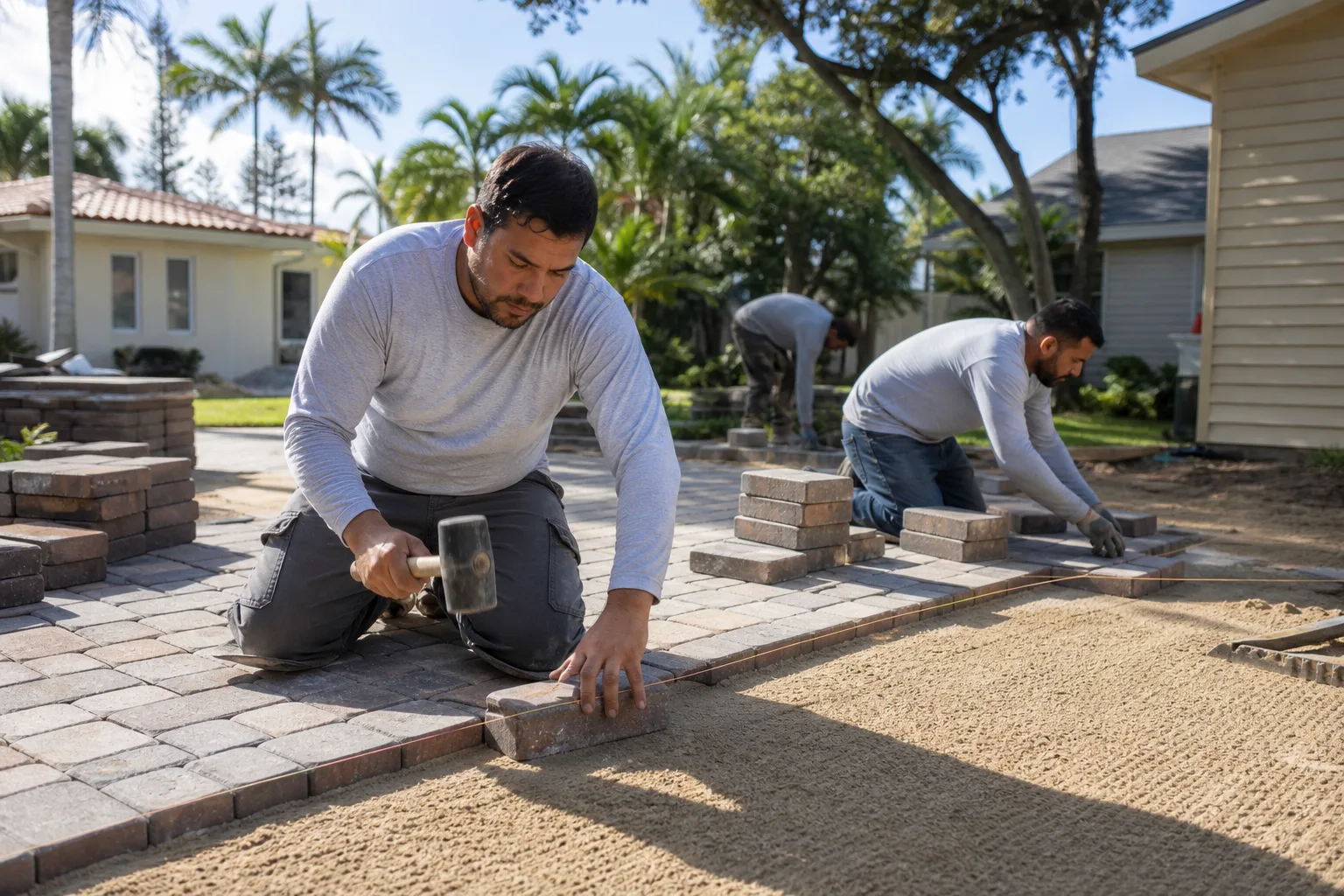
The sequence runs like this. First, the polymeric sand in the joints begins to erode at the surface from foot traffic and hose washing. Second, the joints open far enough for water to penetrate during the October-through-March rains. Third, the water reaches the base layer and the underlying clay soil, which swells when wet. Fourth, the swelling lifts a section of pavers by a fraction of an inch – enough to break the interlock. Fifth, one paver starts rocking, then the ones beside it, and the base under that whole panel loosens. Sixth, a visible depression appears, usually after the rains stop and the soil shrinks back.
Each of those six steps has a repair cost. Step one is an $80 bag of polymeric sand. Step six is a re-lay of the affected panel, which runs several times that. The whole point of a checklist is to catch the sequence early. If you’re reading this because your Garden Grove driveway already thuds, skip to the repair-costs section – the sequence is further along than surface inspection suggests.
Polymeric Sand Joint Degradation: The Three Stages
Polymeric sand is the stabilized material that fills the gaps between pavers. It sets firm when cured and keeps the joint locked, blocking water and preventing individual stones from shifting. In Garden Grove, that sand degrades on a fairly consistent timeline driven by summer UV and winter rain. Here’s what to look for at each stage.
Stage 1 – Six Months After Installation or Top-Off
The surface of the joint still looks tight, but a firm thumb press reveals give. Surface grains begin to wash away at the edges where the driveway meets the apron and where water flows fastest. Damage is cosmetic at this stage. A quick top-off with fresh sand takes under an hour.
Stage 2 – Eighteen Months
Joints have dropped a quarter-inch or more below the paver face. You can feel it with a flathead screwdriver, or with the joint-depth test described below. Water now pools in the joints during rain instead of sheeting off. This is the critical window – the sand is still holding the pavers together, but the base is starting to see moisture. Re-sanding now is a weekend job with a bag of polymeric sand and a broom.
Stage 3 – Full Failure at Three to Four Years
Joints have lost most of their material. Individual pavers rock underfoot. Water channels straight through the driveway into the base. At this stage, re-sanding without addressing the base is a temporary patch – the underlying soil is already working against you. Full re-jointing plus inspection of the base under any loose section is the correct repair.
Expansive Soil and What Base Depth Actually Resists It
Garden Grove sits on soils classified as Class 4 expansive per the USDA soil survey – some of the most reactive in Orange County. What that means in plain terms: the clay literally changes volume with moisture. When it’s saturated, it swells; when it dry-dries through a Southern California summer, it shrinks back, frequently leaving a gap under a rigid surface above.
Concrete fights that movement and cracks. Pavers are supposed to absorb it because the joints and base act as a flexible system. But the flexibility only works if the base was built deep enough to bridge over the seasonal expansion – and that number matters.
For a residential driveway rated for passenger vehicles, the base layer (usually Class II road base or a comparable crushed aggregate) should be a compacted 6 to 8 inches over the subgrade, with a 1-inch bedding layer of washed concrete sand under the pavers. Where the soil is Class 4 expansive, we won’t pour pavers on less than 8 inches unless a geotextile separator is used to decouple the base from the swelling clay. If your driveway was installed with a thinner base – say 4 inches – it may look fine on the surface and still lift at the first hard rain.
You can’t inspect base depth without pulling up a paver. But a driveway that develops depressions in the same spot every spring after rain is screaming that the base is too thin. That’s a base-compaction and depth problem, not a sand problem.
If you’re also fencing in a Yard MD or West Garden Grove backyard, the same soil properties affect fence post footings – worth understanding before you install. See our Fence Installation in Garden Grove guide for the footing depth those posts need in the same soil.
The Month-by-Month Garden Grove Inspection Calendar
Garden Grove’s weather splits into three distinct phases – an October-through-March rain season, a May-to-June marine layer period of high humidity, and a July-through-September dry season with peak UV. The checklist below ties each inspection to the phase that’s actually testing the surface.
- October (before the rains): Walk the full driveway. Run the joint-depth test on at least five sections. Re-sand any joint below a quarter-inch depth. This is the single most important inspection of the year, because a properly jointed driveway will shed the rain. A leaky one won’t.
- November through March (in the rain): Watch drainage. After a heavy storm, check for standing water forty-eight hours later. Any pooling spot is a slope or base problem. Don’t wait for the water to disappear – it’s doing damage while it sits.
- April (post-rain reassessment): Walk the driveway again. The soil has expanded and shrunk once. Any new rocking paver or depression is your first real base signal. This is the second most important inspection of the year.
- May through June (marine layer): The humidity from the June gloom season is the worst time for efflorescence – the white mineral haze that surfaces when water is trapped under the pavers. Inspect for it and clean promptly. It’s cosmetic, but it’s a moisture signal.
- July through September (peak UV): Check the sealer. On unshaded Garden Grove driveways, sealer degrades faster than on shaded ones. Look for dull, chalky patches and water that doesn’t bead on the surface. Target re-sealer every three to five years, sooner if you see either sign.
- Yearly (any dry month): Pull weeds from every joint that has one. Weeds work like a wedge – their roots pry pavers apart from below. Hands and a flathead screwdriver, not a pressure washer.
If you’re planning a broader property upgrade alongside the driveway – say a new kitchen or an ADU – the sequencing matters: pavers and hardscape should go in before the dumpsters and staging damage the surface. Our Home Additions & ADU in Garden Grove guide covers staging and site protection if you’re considering both in the same period.
Sealers Rated for Southern California UV
Not all sealers are created equal, and the difference matters more in Garden Grove than most homeowners realize. The region’s summer UV index hits extreme ratings through July and August, and a sealer that would last five years in a milder climate can break down in three here. Two brands we specify regularly are Techniseal and SRW Products – both make product lines formulated for high-UV markets.
The two types and where each makes sense:
- Film-forming sealers (acrylic-based): These give the wet-look finish a lot of homeowners want. They last 2 to 4 years in Southern California exposure and need reapplying more often. A film-forming sealer trapped over a damp base will turn milky – never apply when rain is within forty-eight hours.
- Penetrating sealers (siloxane or silane-based): These soak into the paver and don’t change appearance. They last 3 to 5 years, sometimes longer, because UV has less to attack. This is our default for Garden Grove unless a homeowner specifically wants the wet look.
Re-application intervals, not vague “periodically”: film-forming re-sealer every 2 to 4 years; penetrating sealer every 3 to 5 years. If your driveway is unshaded and faces west, expect to be at the low end of both ranges. Test by sprinkling water on the surface in a dry month – if it soaks in within ten seconds, the sealer is done.
For a wider view of how the paver system fits together – base, joints, sealer, edging – see our Driveway & Pavers in Garden Grove service guide.
Three Physical Tests You Can Run Without Tools
You don’t need a moisture meter or a pry bar to figure out whether your driveway needs a re-sand or a contractor. These three checks use nothing but your body and a flathead screwdriver you probably have in a kitchen drawer.
1. The Rocking Stone Test
Walk the full driveway in a normal gait, then again slowly. Any paver that tips or clunks underfoot is a rocking stone. A single rocking paver near the edge is often just one joint that needs re-sanding. Two or more rocking pavers in the same section means the base under that panel has loosened. That’s contractor-level.
2. The Joint-Depth Gauge Test
Take a flathead screwdriver and lay its flat tip across the paver joint. Push the tip down into the joint until it hits sand. Mark where the paver face sits on the shaft with your thumb. Any joint deeper than a quarter-inch needs re-sanding. Any joint that crumbles when poked – that is, the sand doesn’t hold together – has lost its binder and needs full replacement, not a top-off.
3. The Drainage Slope Check
On a dry day, run a garden hose across the driveway for two minutes toward the street or drain. Water should sheet off and clear within a minute. Any puddle that lingers more than fifteen minutes is sitting where the slope has flattened or the pavers have settled. Slope problems and settled pavers aren’t DIY – they need a contractor to lift, adjust the base, and re-set the panel.
If all three tests come back clean, you’re on the maintenance track: re-sand and re-seal on schedule and you’ll get the full life out of the surface. If any of them flags a base problem, keep reading – the cost difference between addressing it now and next spring is significant.
What Paver Repairs Cost in Garden Grove
Here’s the honest cost picture for Garden Grove, in dollars you can compare against a competitor’s quote. Prices vary by driveway size, access, and whether the base layer needs partial rebuild, but these ranges reflect what we see most often on residential driveways in the area.
- Polymeric sand top-off (re-sand, no base work): $80 to $300 in materials and DIY labor, or $400 to $900 as a contracted job for a typical two-car driveway.
- Full joint replacement including sand removal: $900 to $1,600 depending on square footage and access.
- Sealer application (materials plus labor, penetrating sealer): $600 to $1,400 for a standard two-car driveway.
- Single-panel re-lay with base inspection: $1,200 to $2,800 depending on whether the base needs partial rebuild.
- Full driveway re-lay (base rebuild plus new pavers): $8,000 to $18,000 in the Garden Grove market for a typical 500-700 square foot driveway, depending on paver brand. Belgard and Techo-Bloc sit at the higher end of that range.
- Full driveway replacement with concrete instead of pavers: $5,000 to $11,000 – but concrete doesn’t flex with Class 4 expansive soil, so expect cracking within a decade unless it’s reinforced and jointed aggressively.
The pattern to notice: re-sanding at eighteen months costs a fraction of re-laying at four years. That’s the whole financial argument for the checklist. For a more detailed breakdown of brands and base build-up, our Rowan Construction Group Garden Grove home page covers the full project scope across all seven trades we handle.
Common Mistakes to Avoid
- Pressure washing the joints. A pressure washer at 3,000 PSI will strip the polymeric sand out of the joints in one pass. Homeowners do this thinking they’re cleaning the driveway – they’re actually accelerating the failure by months.
- Re-sanding over wet joints. Polymeric sand needs to be applied to a dry joint and cured with a light mist. Applying it to a damp joint leaves the binder weakened and the sand washes out at the first rain.
- Filling cracks and joints with concrete or mortar. These crack and pull away from pavers within a year in Garden Grove because the pavers are moving and the concrete isn’t. The repair looks worse than the original problem.
- Panic-sealing to “protect” a failed driveway. If the joints are already stage-3 failed and the base is loose, sealing traps moisture and makes the next repair harder. Diagnose first, seal second.
- Ignoring efflorescence as a cosmetic issue. White mineral haze on Garden Grove pavers is usually a signal that water is trapped under the surface with nowhere to drain. Treat it as a moisture signal, not just a stain.
- Applying film-forming sealer before the June gloom season. Marine layer humidity extends cure time and can leave a milky haze. Apply in a dry window and get the coating fully cured before the humidity arrives.
- Letting weeds establish in the joints. A single weed in a paver joint pries the paver apart from below over a single season. Pull them when they appear – the correction is expensive once the interlock is gone.
When to Call a Professional
Some jobs are weekend work; some aren’t. Here’s the line. Call a contractor when two or more pavers in the same section rock underfoot, when any paver has lifted or heaved after a rain, when water pools for more than fifteen minutes after a heavy storm, when you can poke a screwdriver more than a quarter-inch into a joint and have it crumble, or when the sealer test fails two years after your last application. Those are the signals that the base – not the sand – is the problem. Base work requires lifting, re-compacting, and re-setting pavers with proper depth and compaction. It isn’t a homeowner job if you want it to last.
Rowan Construction Group Garden Grove offers free estimates in Garden Grove. We quote a flat written price before any work starts, back every job with the 365-Day Done Right Promise, and give you a documented photo record of what we found and what we did. Call (888) 303-8980 to schedule your free estimate.
Frequently Asked Questions
Every 18 to 24 months for a properly sealed driveway, and sooner if you see joint depth drop below a quarter-inch. The October inspection before the rain season is the right time to catch it. Polymeric sand in Garden Grove degrades faster than in milder climates because of the UV exposure, so the low end of that range is safer for west-facing, unshaded driveways.
Pavers are usually the better choice in Garden Grove because the region’s Class 4 expansive soil moves with moisture and pavers are designed to flex with it while concrete cracks. Concrete costs less upfront – $5,000 to $11,000 for a typical driveway versus $8,000 to $18,000 for pavers – but concrete in this soil needs aggressively engineered reinforcement and control joints to avoid early cracking. Pavers also let you lift and re-level a single panel without demolishing the driveway.
Sunken sections are almost always a base problem, not a paver problem. The most common cause in Garden Grove is polymeric sand washing out of the joints over one to two rain seasons, which lets water into the base, which lets the underlying clay soil swell and then shrink back after the rain stops. The result is a void under the pavers and a depression at the surface. A second, less common cause is an under-built base – less than 6 to 8 inches of compacted road base – which can’t bridge the seasonal soil movement.
If your joints are deep-clean and structurally sound, self-application of a penetrating sealer is realistic for a homeowner with an afternoon and proper equipment. Film-forming sealers are less forgiving – they require a thoroughly clean, dry surface and even coverage, or you’ll get visible haze. If there’s any joint or base work needed first, hire a contractor – sealing over a failing driveway traps moisture and makes the next repair more expensive.
Twenty-five to thirty-five years for the pavers themselves with proper maintenance – re-sanding on schedule and re-sealing every three to five years. The paver surface rarely wears out; it’s the joints and base that need attention. A driveway that’s ignored for a decade often needs a full re-lay not because the stones failed, but because the base under them did.
Permits for paver driveways in Garden Grove depend on scope and whether you’re changing the lot’s drainage, impervious surface coverage, or grade. We handle the assessment and pull permits where they’re required. Every Rowan project starts with a written price and written scope before work begins, and no change order proceeds without your signature. Call (888) 303-8980 for an exact answer on your driveway – estimates are free.
The Bottom Line
Driveway pavers in Garden Grove fail in a sequence, not at random. Polymeric sand degrades in a predictable three-stage curve, Class 4 expansive soil underneath tests the base every wet winter, and the fix goes from $80 at the top of the sequence to several thousand at the bottom. The October and April inspections are the two dates that matter most on your calendar. Re-sand when the joint depth slips past a quarter-inch, re-seal a UV-rated product on the penetrating sealer schedule, and leave base work to a contractor. That’s the whole protocol.
Rowan Construction Group Garden Grove quotes every driveway job with a flat written price before work starts, backed by the 365-Day Done Right Promise and a documented photo record on every visit. Bring us a competitor’s quote and we’ll review it line by line at no charge – our Free Second Opinion covers any written estimate. Call (888) 303-8980 for a free estimate in Garden Grove.
Written by the team at Rowan Construction Group Garden Grove.
See the difference
 Before
 After
 Before
 After
 Before
 After