Last updated November 17, 2026

Free written scope consultation - allowances, timeline, and change-order rules on paper before a single trade is scheduled
Driveway & Pavers Maintenance Schedule: What to Do and When
Polymeric sand, the jointing material that locks pavers in alignment and keeps weeds from finding a foothold, has a functional lifespan of five to eight years under Southern California UV exposure. Almost no homeowner knows when their sand was last replaced, or which brand the original crew used. That gap is where paver driveways fail years before they should. This guide gives Garden Grove homeowners a dated calendar: what to check in February after the rains, what to seal in April before summer, what to inspect in October after the Santa Ana winds. The whole schedule costs under $400 a year in materials and two to three hours of labor, and it’s the difference between a driveway that lasts 30 years and one that needs replacing at 15.
Quick Answer
A paver driveway needs three scheduled inspections and one maintenance pass per year: a post-winter joint and edge check in February, a pre-summer sealer evaluation in April, a post-Santa Ana wind inspection in October, and a sand replenishment or full replacement roughly every five to eight years. Total annual cost for materials runs $150 – $400, and a well-maintained paver driveway outlasts a neglected one by 15 – 20 years.
Styles & brands we work with
- Kitchen remodeling
- Bathroom remodeling
- Home additions & ADU
- Roofing
- Windows & doors
- Driveway & pavers
- Fence
Table of Contents
- Why a Written Schedule Matters More Than a Repair Budget
- The Month-by-Month Garden Grove Paver Calendar
- Polymeric Sand: When to Replace It and How to Identify What You Have
- Choosing the Right Sealer for Your Paver Material
- Edge Restraint: The Failure Point Nobody Checks
- Building a Maintenance Log That Actually Protects You
- What You Can Do Yourself and What You Shouldn’t
- Annual Maintenance Costs, in Dollars
Why a Written Schedule Matters More Than a Repair Budget
We’ve walked a lot of Garden Grove driveways, and the failure pattern is almost always the same. Twelve to fifteen years after installation, joints have opened, sand has washed out, a few pavers have shifted 3/8 of an inch, and one corner near the street has settled where water pools. The homeowner wants to know if the whole thing needs replacing. Usually it doesn’t. It needs the maintenance that was skipped for a decade, done all at once, and that costs three to five times what the annual schedule would have cost in total.
The math is blunt. An annual maintenance budget of $400 covers polymeric sand every five to seven years, sealer every three to five, and the small consumables in between. A full re-sand and re-level of a 600-square-foot driveway runs $1,400 – $2,800 depending on how much base correction is needed. A full replacement runs $9,000 – $18,000 for the same footprint, and that spread is the entire reason a written schedule exists. The schedule is not about polish. It is about deferring a five-figure decision by a decade or more.
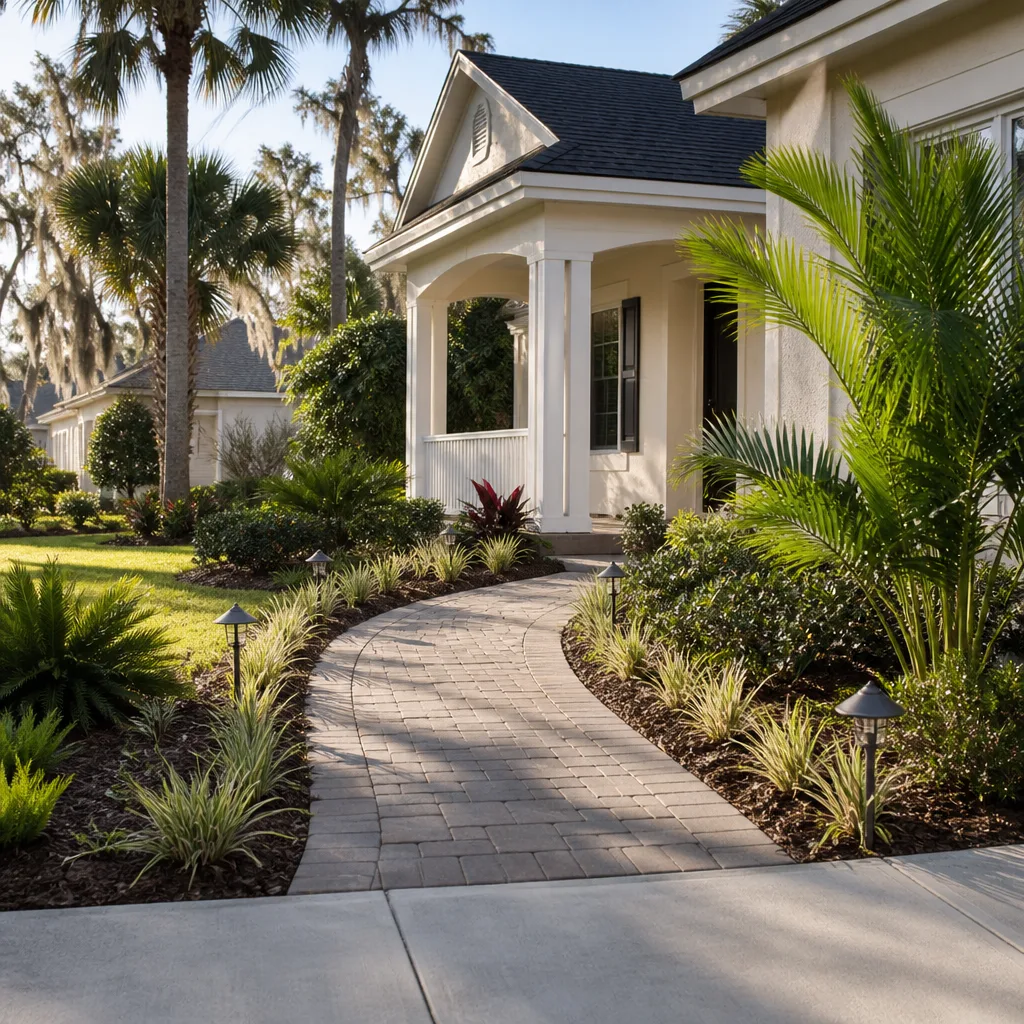
Garden Grove’s climate makes the schedule more important, not less. The city sits on the coastal side of the Santa Ana wind corridor, which means the paver field gets a dry, abrasive, high-velocity event every fall that pushes fine grit into the joints and widens them over multiple seasons. Winter rains then wash that loosened sand out. A driveway in a sheltered neighborhood near Garden Grove Park looks fine ten years in. The same paver on a corner lot near Valley View Street, fully exposed to the October winds, may need re-sanding at year five. The schedule below is written with both cases in mind. For a deeper look at how we install and repair paver driveways in Garden Grove, see our Driveway & Pavers in Garden Grove page.
The Month-by-Month Garden Grove Paver Calendar
The schedule below is specific to Garden Grove’s climate pattern: wet winters (December through March), a long dry season (May through October), and a fire-season wind event in October and November. Adjust dates by a week or two in any given year based on rain, but do not skip the tasks.
- February – Post-Winter Inspection. Walk the driveway after the last significant rain of the season. Look for open joints (a visible gap wider than 1/8 inch), puddles that sit more than 24 hours after rain stops, and any paver that rocks underfoot. Mark problem spots with chalk. This is also the moment to check for weed growth in the joints, which is the first visible sign your polymeric sand has failed.
- March – Joint Replenishment. Re-sand any open joints with fresh polymeric sand before the dry season. This is the single most important annual task, and it’s why the schedule exists.
- April – Pre-Summer Sealer Evaluation. Water-bead test: pour a cup of water on the surface. If it beads and rolls off, the sealer is still working. If it absorbs within 30 seconds, the sealer has failed and needs replacement before summer UV hits.
- May through September – Monthly Walk-Through. Ten minutes. Check for new weed growth, loose pavers, and standing water. Note anything that appeared since last month. Nothing else is needed unless something is flagged.
- October – Post-Santa Ana Inspection. After the first Santa Ana wind event, inspect all joints for grit intrusion and open gaps. Winds push fine dust into joint spaces and widen them seasonally. This is when a re-sand most often becomes due in Garden Grove, and skipping it leads to failed joint material by spring.
- November – Sealer Reapplication (if due). If the April test showed failure, apply sealer before the rains return. Temperature window matters: apply when daytime highs are 60 – 85°F with no rain forecast for 24 hours.
- December – Edge Restraint Check. Run a hand along every visible edge restraint. Fastener heads should be flush or slightly countersunk. Any deteriorated spikes or clips need replacement. This is the annual task that almost no one does, and covered in detail below.
Polymeric Sand: When to Replace It and How to Identify What You Have
If you don’t know which brand of polymeric sand is in your joints, that is the first task: identify it. Brand matters because the two product classes behave completely differently in Southern California UV. High-performance polymeric sand like Techniseal HP+ is formulated with UV-stable polymer binders and a fine-grain polymer ratio that locks the joint over five to eight years in full sun. Generic big-box polymeric sand of the previous generation typically fails in three to four years in Garden Grove exposure, and when it fails it fails by turning to loose grit, not by gradually releasing.
Here’s how to tell what you have:
- Check the joint surface. Techniseal HP+ and similar modern products cure to a slightly rubbery, firmly bound surface that repels water when new. Older generic sand cures hard and brittle, and eventually crumbles.
- Look for stray granules. If your joints shed sand onto the driveway surface after light traffic, the polymeric binder has already failed.
- Check the original job paperwork. A written scope from the installing contractor should list the product by name. If you don’t have one, that is the documentation gap this guide is meant to prevent – and a reason to start a log now.
- Look at anthill activity. Modern UV-stable sands include an ant deterrent in the polymer formula. Joints already colonized by ants typically mean a generic sand without that ingredient.
Replacement indicators to watch for: joints visibly open wider than 1/8 inch, weeds sprouting within 6 months of a previous re-sand, visible sand loss in the traffic-pattern center of the driveway, or visible grass growing from the joints after a single season. Any of those means the joint material has failed and needs full replacement, not spot patching. For homeowners considering a full new installation or replacement, our Rowan Construction Group Garden Grove home page lays out the trades and standards we apply across every project, and our driveway and pavers page details how we spec the joint material on new installs.
Choosing the Right Sealer for Your Paver Material
Sealer selection is the most common mistake we see on Garden Grove driveways, and it is expensive when done wrong. Sealers come in two families: penetrating (sometimes called impregnating) sealers and film-forming sealers. They are not interchangeable, and using the wrong one on the wrong pavers causes the failure you were trying to prevent.
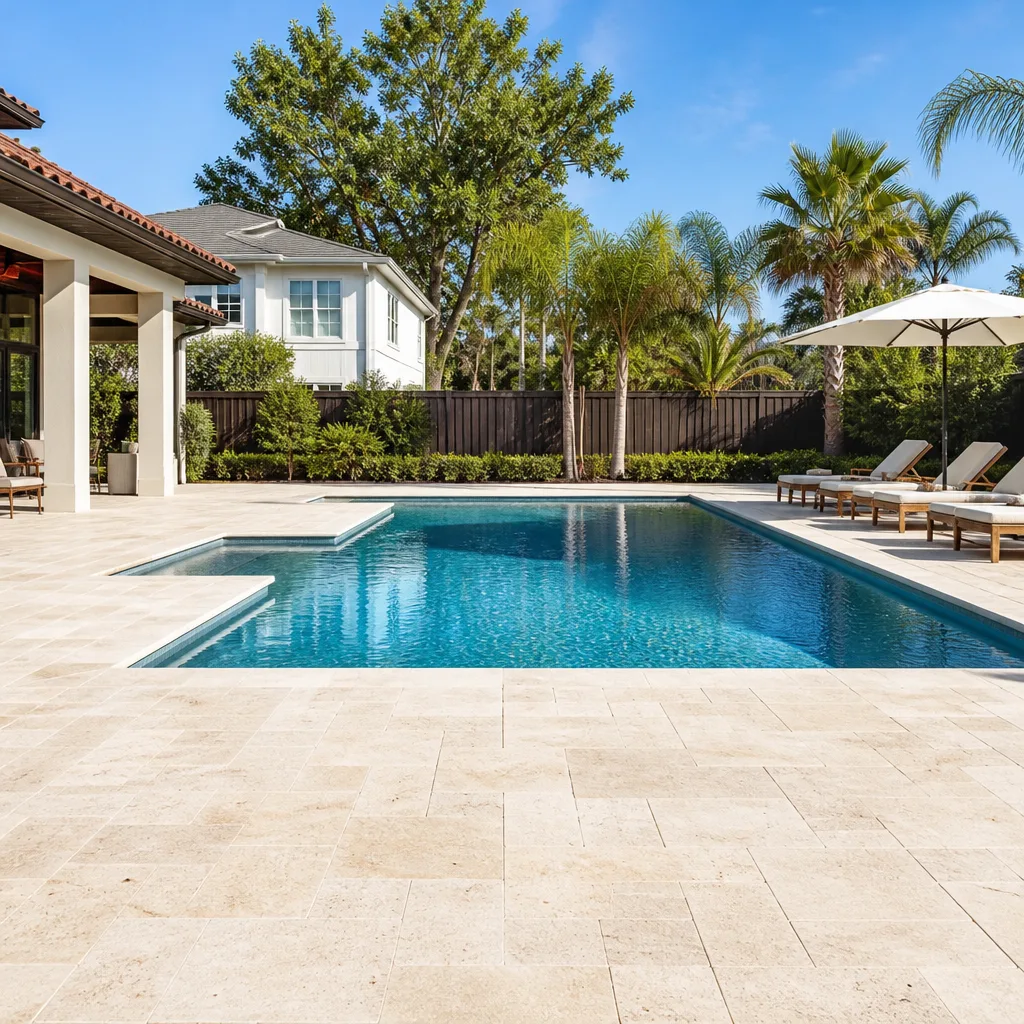
- Penetrating sealers soak into the surface and chemically bond below it, leaving no visible film. They are the correct choice for natural stone pavers (travertine, limestone, sandstone, bluestone, granite). Film-forming sealers can trap moisture under the film on natural stone and cause spalling or efflorescence. Penetrating sealers typically need reapplication every three to five years.
- Film-forming sealers sit on the surface and form a visible coating. They are appropriate for concrete pavers and mechanically pressed clay pavers, where the film adds stain resistance and enhances color. They need reapplication every two to four years in full sun, or more frequently on a south-facing driveway.
- Do not use a film-forming sealer on travertine or limestone in Garden Grove. The combination of coastal humidity and hot summer afternoons traps moisture under the film, and the failure shows up as peeling, whitening, or surface spalling within one or two seasons.
- Do not use penetrating sealer on concrete pavers if you want color enhancement. Penetrating sealers leave the surface looking unchanged. If the color is important to you, use a film-forming product suitable for concrete.
The April water-bead test tells you when sealer is due. For a 400-square-foot driveway in Garden Grove, sealer cost runs $80 – $180 for film-forming products and $150 – $300 for penetrating sealers, depending on coverage rate and number of coats. The other trade decision – concrete pavement versus pavers – is a separate conversation. If you are deciding between the two, comparison shopping at a written quote level is the honest approach, and we’ve written about our Driveway & Pavers in Garden Grove work with that comparison in mind.
Edge Restraint: The Failure Point Nobody Checks
Edge restraint is the aluminum or plastic channel, or the concrete curb, that holds the paver field from spreading outward. It is the most reliably skipped item on every homeowner’s maintenance list, and when it fails the paver field starts spreading outward by millimeters per year. Once the pavers spread, the joints open, and the polymeric sand washes out. Edge failure is the upstream cause of most joint failures we diagnose.
Two common edge systems are used in Garden Grove, and each needs a specific inspection protocol.
- Snap Edge L-shaped aluminum restraint. The vertical leg sits against the paver field, and the horizontal leg is fastened to the base with spikes. Check that each spike is fully seated and not rocking when you push on the vertical leg. Standard spacing is one spike every 12 – 16 inches along the restraint, with an anchor spike within 6 inches of every corner and end. Push every spike head with your thumb. Any spike that rocks, or any head that has lifted more than 1/16 inch above the horizontal flange, needs replacing before the next wet season.
- Pave Tech and similar plastic edge restraint. Fastened through pre-drilled holes with 8- to 10-inch spikes into the base. Check spike depth: the spike head should contact the flange with no gap. Plastic restraints can crack in UV over 10+ years of exposure; any cracked section should be replaced, not glued, because glued repairs fail at the first Santa Ana wind event.
On both systems, check the corners first. Corners take the most load and fail first. On driveways in Garden Grove where the apron transitions to the public sidewalk, the restraint nearest the sidewalk gets the most impact load from vehicle turning, and that is typically where we find the first failure. If any paver can be pushed inward toward the lawn or planter by hand, edge restraint has already failed and the repair should not wait. This is one of the specific checks our crews complete on every paver job, and if you’re comparing quotes, ask whether edge restraint inspection is included in the written scope.
Building a Maintenance Log That Actually Protects You
The maintenance log is the least glamorous part of this guide and the one that pays off in two specific scenarios: a warranty claim and a property sale. In both cases, documented evidence that the paver driveway has been maintained on a schedule is a material fact that changes the outcome.
A useful log takes five minutes per task and includes:
- Date and task. “Feb 14 – post-winter inspection, 4 open joints marked, no rocking pavers.”
- Product names and brands. “Re-sanded with Techniseal HP+ Platinum, 1 bag, applied Mar 2.” Brand names in the log are what make it useful; “polymeric sand” alone is not evidence, and ambiguity leaves room for dispute.
- Photos. One photo per task, taken at a consistent angle (say, from the corner of the garage looking toward the street). A dated photo series is the strongest evidence in a warranty or sale dispute.
- Contractor name and written scope. When work is done by a contractor, record the written quote, the completed scope, and the written warranty. This is the discipline that we build into every job, and any homeowner who works with Rowan Construction Group on a paver project gets a documented photo record on every visit as a standard deliverable – it is not an upgrade.
- Repairs and edge restraint events. Log any spike replacement, any paver reset, any sealer reapplication. Documented repairs do not reduce resale value; undocumented repairs reduce it.
If you have no log and no paperwork from the original installation, start a log today with a baseline entry: current condition, identified joint material brand if possible, and a set of dated photos. A log started late still counts as evidence of due diligence going forward, and if a dispute arises around a warranty claim, the question a court or adjuster will ask is whether the owner acted reasonably. A dated log answers that question in plain terms.
What You Can Do Yourself and What You Shouldn’t
Most of this schedule is safe and reasonable for a homeowner to own. Walking the driveway, inspecting joints, checking water beads, and keeping a log requires no special tools or training. Re-sanding joints is also within reach if you’re willing to do it carefully – it’s not a dangerous task, it just has a slow learning curve. The parts of the schedule that go wrong with DIY are the ones that involve the base and the edge.
- Do yourself: The monthly walk-through, the April water-bead test, the annual edge-restraint spike check, the maintenance log, the fall joint inspection, and spot re-sanding of one or two open joints.
- Consider carefully: Full re-sanding (a 400-square-foot driveway needs about 2 – 3 bags of polymeric sand, a squeegee, a plate compactor rental, and a dry day – call it a full Saturday for a first-timer), and sealer application in the correct temperature window.
- Call a professional: Base correction. Any paver that rocks visibly underfoot, any puddle that sits more than 48 hours after rain, and any edge restraint that has pulled loose need to be diagnosed by a crew that can check the base layer under the paver, not just reset the surface paver. Resetting the top paver without correcting the base is a temporary fix that fails the next wet season.
- Never DIY: Full paver replacement or expansion, and base rebuilds. Those are structural work, and the difference between a driveway that performs for 30 years and one that needs redoing at 12 is the base layer, which is invisible from the surface. For homeowners planning driveway work alongside other projects, the standards we apply on our Home Additions & ADU in Garden Grove pages apply to paver base work too: written scope, documented substrate, signed change orders before any deviation. The same discipline carries into fence and boundary work; our Fence Installation in Garden Grove team coordinates with paver crews when the fence shares an edge with the driveway.
Annual Maintenance Costs, in Dollars
Below is what the full annual schedule costs in Garden Grove in materials, assuming a 400 – 600 square-foot paver driveway. Labor is what you save by doing the walk-through and inspection yourself.
- Polymeric sand (re-sand year): $60 – $140 for 2 – 3 bags of Techniseal HP+ or equivalent high-performance product. Skip the $20 bag at the big-box store; the failure mode is documented and the replacement cost is higher.
- Polymeric sand (non-re-sand year): $0-$40 for a single bag to spot-fix.
- Film-forming sealer, concrete paver driveway: $80-$180 per application.
- Penetrating sealer, natural stone driveway: $150-$300 per application.
- Edge restraint spike replacement, as needed: $5-$30 for a handful of spikes; a contractor callout for edge repair runs $150-$400 depending on length.
- Annual total (materials only, averaged over five years): $150-$400 per year, with the higher end for stone driveways with more frequent sealer cycles.
Compare that to the replacement cost of the same driveway. A 500-square-foot paver driveway in Garden Grove runs $9,000-$18,000 to replace, and replacement is what happens when the annual schedule is skipped for ten or more years. The materials budget over the same ten years is $1,500-$4,000. The schedule pays for itself roughly four to twelve times over in a single replacement cycle, before any consideration of resale value.
Common Mistakes to Avoid
- Buying the cheapest polymeric sand on the shelf. Generic big-box sand frequently fails in three to four years in Garden Grove UV; the savings of $20 – $40 per bag costs $600 – $1,200 in re-sand labor four years later.
- Applying film-forming sealer to natural stone pavers. Traps moisture under the film, causes spalling. Use penetrating sealer on travertine, limestone, and sandstone.
- Ignoring the edge restraint because the pavers look fine. Edge failure precedes joint failure by 12 – 24 months. By the time joints open visibly, edge repair is due too.
- Skipping the October inspection. The post-Santa Ana joint inspection is the one most often skipped in Garden Grove, and it is the inspection that catches the joint damage that spring rains will compound.
- Sealing a driveway that hasn’t been re-sanded first. Sealing over open joints locks the gaps in place and prevents the re-sand from bonding. Re-sand, then cure, then seal – never the other way around.
- Assuming the original contractor’s warranty covers maintenance failures. A workmanship warranty covers installation defects, not failed maintenance. A documented log is what distinguishes one from the other.
- Using a pressure washer on full blast to clean joints. High-pressure water pushes joint material out and accelerates base saturation. Use low pressure with a fan tip, or a garden hose and a stiff brush.
See the difference
 Before
 After
 Before
 After
 Before
 After
When to Call a Professional
Call a professional when any of these apply: a paver rocks visibly underfoot, a puddle sits more than 48 hours after rain, any edge restraint has pulled loose or a spike has lifted more than 1/16 inch, or the driveway has gone more than eight years without a documented re-sand. Also call if you cannot identify the joint material brand and the driveway is more than five years old – a professional inspection can determine whether full sand replacement is due and what product should be specified.
The other honest call-the-pro scenario is pre-sale. If you are preparing to list a property and the paver driveway is 10+ years old, a professional inspection with a written report and a documented photo record is worth the small cost; it converts a potential buyer objection into a documented positive. Rowan Construction Group Garden Grove offers free estimates in Garden Grove – call (888) 303-8980. Every written quote comes with a written scope and a written warranty before any work starts.
Frequently Asked Questions
Every five to eight years for high-performance polymeric sand, or every three to four years for generic big-box sand. The October post-Santa Ana joint inspection is when you confirm whether re-sand is due. If joints are open wider than 1/8 inch, re-sand is overdue. Call (888) 303-8980 for a free estimate if you’re not sure.
No. Penetrating sealers are the correct choice for natural stone pavers – they leave no visible film and breathe with the stone. Film-forming sealer on travertine traps moisture and causes spalling, especially in Garden Grove’s coastal humidity.
$150 – $400 per year in materials, averaged over a five-year cycle, for a 400 – 600 square-foot driveway. That includes polymeric sand on the replacement cycle, sealer, and small consumables. A full re-sand and level of the same driveway runs $1,400 – $2,800, and full replacement runs $9,000 – $18,000. The schedule pays for itself in a single replacement cycle.
Push on the vertical leg of the edge restraint at a corner. If it moves, or if any spike head has lifted more than 1/16 inch above the horizontal flange, it needs repair. On a Snap Edge system, check that every spike is fully seated with no rocking. On a Pave Tech plastic system, look for cracks along the flange – cracked sections need replacement, not gluing.
Yes, and specifically because it matters in two scenarios: a warranty claim and a property sale. A dated photo series plus product brand records is the strongest available evidence of due diligence. A log started today is still useful; the first entry establishes the baseline condition.
A re-sand and edge repair on a 400 – 600 square-foot Garden Grove driveway typically takes one to two days depending on curing windows and weather. A full re-sand plus sealer is usually a two-day job. Full replacement runs three to five days. Every Rowan Construction Group Garden Grove quote includes the timeline in the written scope before work starts, and no change proceeds without a signed change order. Call (888) 303-8980 for a free estimate.
The Bottom Line
A paver driveway maintained on a documented annual schedule outlasts a neglected one by 15 – 20 years, and the entire schedule costs under $400 per year in materials, plus two to three hours of homeowner labor. The tasks are specific: February post-winter inspection, March re-sand of any open joints, April sealer bead test, October post-Santa Ana joint inspection, December edge restraint check. Product brand matters – Techniseal HP+ or equivalent high-performance polymeric sand, the correct sealer family for the paver material. The log matters too, because a dated record is what turns maintenance from a chore into documented due diligence. Skipped maintenance is the most expensive decision most homeowners make about their driveway, and it is entirely preventable.
Rowan Construction Group Garden Grove offers free estimates on every paver project and free second opinions on any written estimate from another contractor. Every project comes with a flat written price before work starts, a written scope and warranty, a documented photo record on every visit, and the 365-Day Done Right Promise. Call (888) 303-8980 to schedule your free estimate.
Written by the team at Rowan Construction Group Garden Grove.